
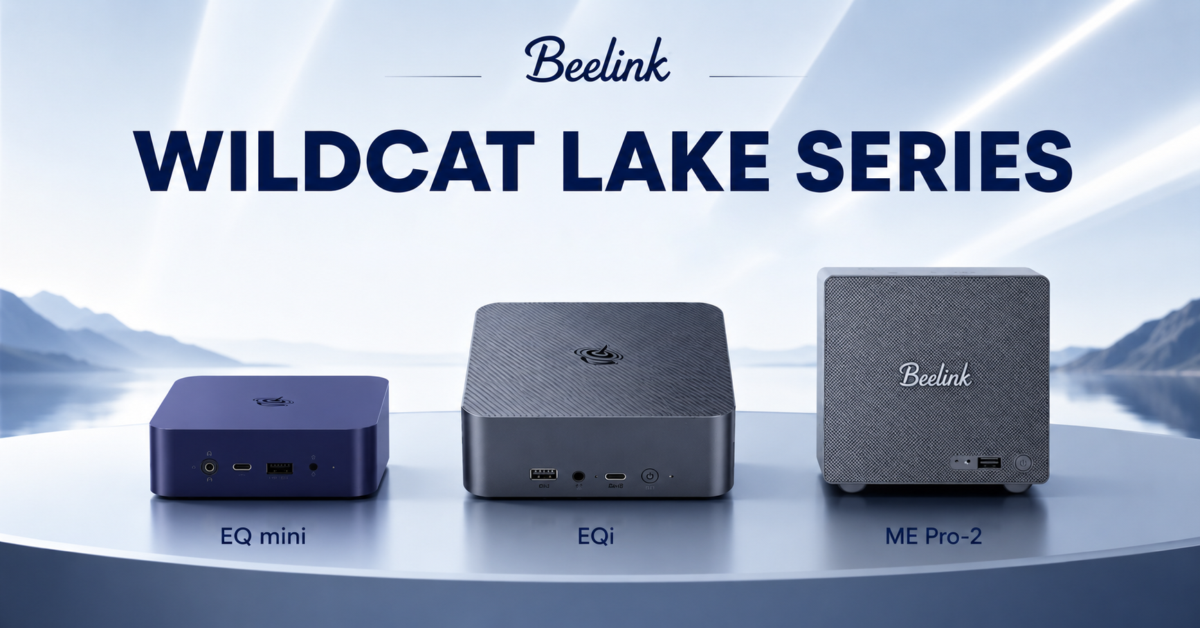
Beelink is betting that folks want AI capable desktop hardware without giant towers, loud fans, or sky high prices. The company has officially unveiled its new Wildcat Lake lineup powered by Intel’s latest low power platform, and the systems look aimed squarely at people who want compact machines with serious connectivity. The new family includes the EQ mini, EQi, and ME Pro-2, all built around Intel’s new Core 3 304 processor and Intel’s 18A process technology.
What makes this launch interesting is not just the tiny form factors, but Intel’s underlying technology. Wildcat Lake uses Intel’s 18A node, which introduces RibbonFET transistors and PowerVia backside power delivery. Intel has talked up these technologies for a while, and Beelink is among the first to actually put them into consumer focused products. According to Beelink, the Core 3 304 processor delivers roughly 120 percent better single core performance and around 60 percent higher multi core performance compared to the older Core i3 N305.
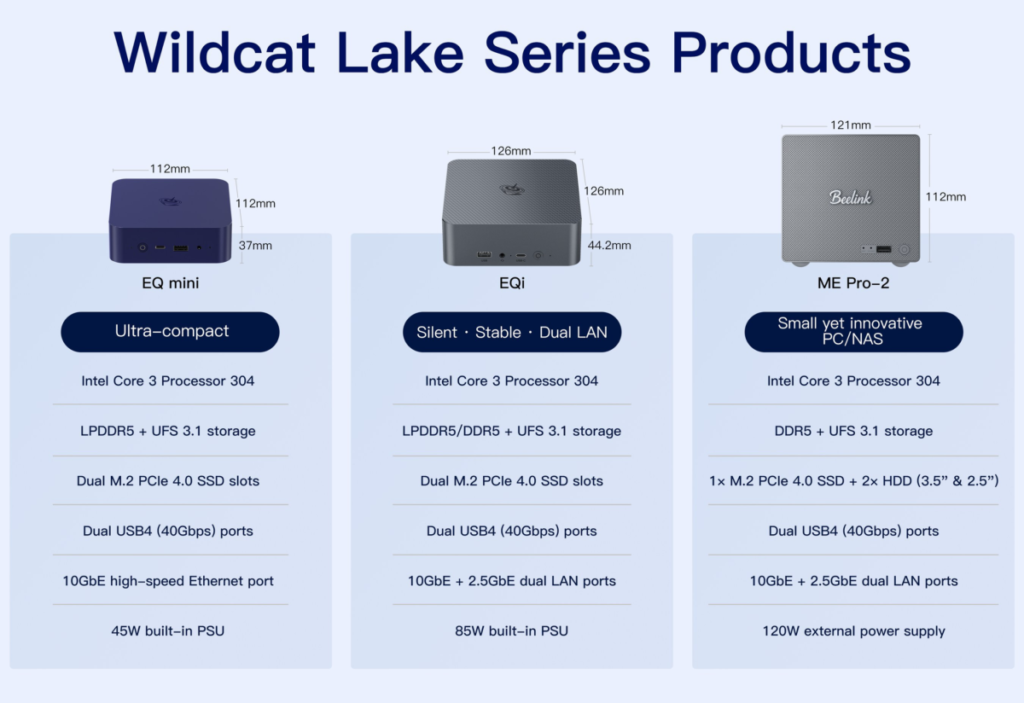
The processor itself is fairly unusual. It combines one Cougar Cove performance core with four Darkmont efficiency cores, plus integrated Xe3 LPG graphics and an onboard NPU for AI workloads. Beelink says the chip can deliver up to 24 TOPS of AI performance, which could make these systems useful for local AI inference, productivity tools, and lightweight creator workflows without depending entirely on cloud services.
All three systems share some premium sounding features despite their small sizes. Every model includes dual USB4 ports with 40Gbps speeds and 10GbE networking, which is pretty wild for compact low power systems. The EQ mini is the smallest of the bunch and targets minimalist desktop setups with a built in 45W power supply. The EQi steps things up with both 10GbE and 2.5GbE Ethernet ports plus an integrated 85W power supply, making it more appealing for networking and edge computing tasks.
The most interesting model might be the ME Pro-2. It combines mini PC hardware with NAS style functionality, including dual drive bays for 3.5 inch and 2.5 inch drives. For Linux users, homelab folks, and data hoarders, that combination of compact size, dual LAN, and local storage expansion could make it particularly appealing.
What stands out here is how quickly AI has become a standard talking point for basically every new PC launch. Thankfully, Beelink seems to be pairing those AI claims with practical hardware features people can actually use, such as fast networking, USB4, expandable storage, and low power operation. That matters more than flashy AI buzzwords alone.
Pricing and release timing were not announced.
Support independent tech journalism
NERDS.xyz is independently owned and operated. If you enjoy my coverage of Linux, AI, hardware, cybersecurity, and tech culture, consider supporting the site on Ko-fi.
Support NERDS.xyz