
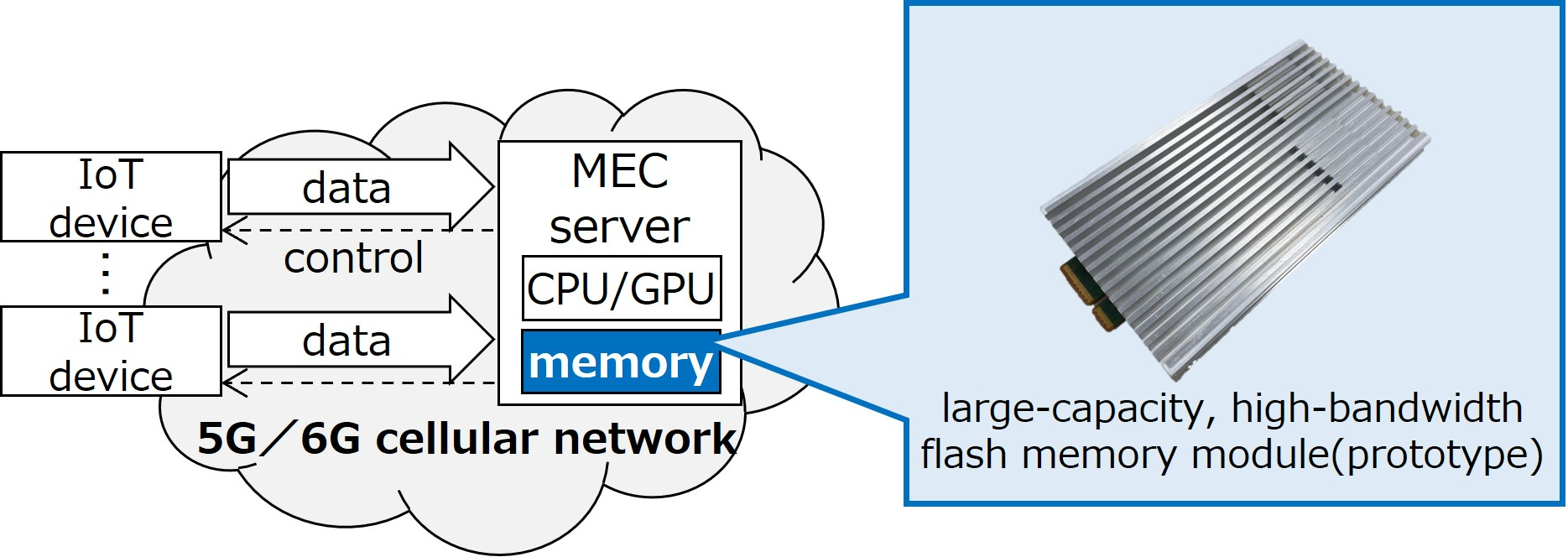
Kioxia has developed a prototype memory module that delivers both size and speed. The flash-based design offers an insane 5TB of capacity and 64GB/s of bandwidth, overcoming the trade-off that has limited conventional DRAM modules.
The work was carried out under Japan’s Post-5G Information and Communication Systems Infrastructure Enhancement R&D Project, commissioned by NEDO. The goal is to create hardware ready for a world of faster networks, lower latency, and heavier data demands.
Instead of a bus connection, Kioxia used a daisy-chain layout that links flash memories through controller “beads.” This approach prevents bandwidth from collapsing as capacity scales upward. On top of that, a 128Gbps PAM4 transceiver enables high throughput while keeping power requirements down.
The company also addressed latency. A flash prefetch system reduces delays by pulling data in advance during sequential reads. Combined with low-amplitude signaling and distortion correction, the flash-to-controller interface reaches 4.0Gbps.
The prototype uses PCIe 6.0 as its host interface and has already been tested. It hit the promised 5TB capacity and 64GB/s bandwidth while drawing less than 40 watts of power. That makes it efficient enough to consider for real-world server deployments.
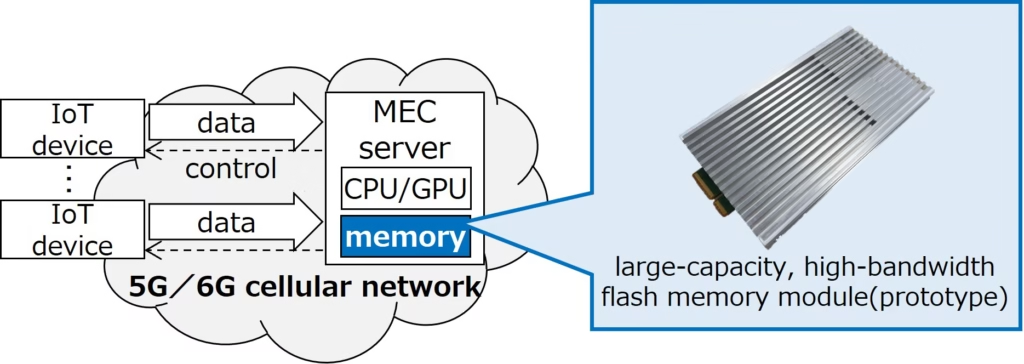
Kioxia expects the technology to play a role in Mobile Edge Computing servers. As 5G and 6G connect more devices, latency from relying on distant cloud servers becomes a problem. By pushing powerful memory closer to users, industries can support real-time workloads in AI, IoT, and big data analysis.
The company also sees opportunities in generative AI, where memory bandwidth is often a bottleneck. It plans to move toward commercialization, bringing this prototype closer to practical use.
Support independent tech journalism
NERDS.xyz is independently owned and operated. If you enjoy my coverage of Linux, AI, hardware, cybersecurity, and tech culture, consider supporting the site on Ko-fi.
Support NERDS.xyz