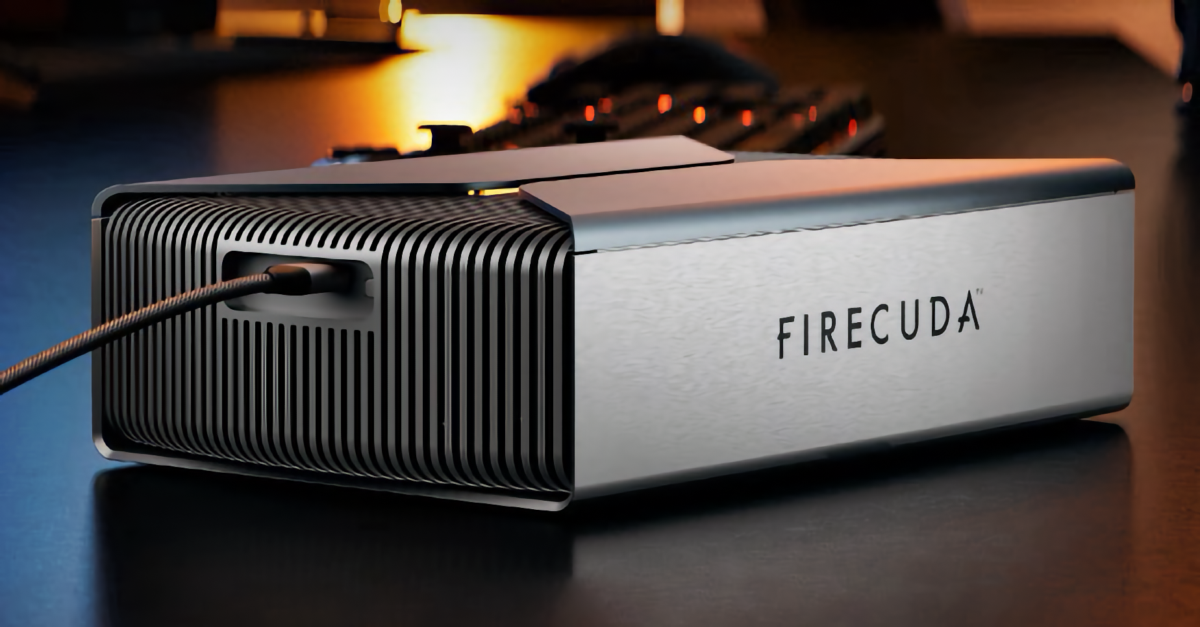
Spending $699 on external storage and then having to supply another drive might sound like a tough sell. That is the proposition behind the new Seagate FireCuda Forge, although the company has a reason for asking buyers to bring their own SSD.
The FireCuda Forge combines a high-capacity hard drive with a user-provided NVMe SSD, using a new platform called Alkemi to manage the two. Seagate is pitching it at gamers and creators who want fast access to their active files without sacrificing room for an expanding collection.
The important detail is that the SSD is required for operation. This is not an optional upgrade you can skip while using the included hard drive, so anyone considering a purchase needs to account for that before reaching for a credit card.
Seagate announced the FireCuda Forge in 8TB and 20TB configurations, starting at $699 and $899, respectively. Both include the hard drive, with buyers choosing and supplying the NVMe SSD themselves.
Alkemi is the part intended to make this arrangement useful. Its dynamic-caching technology learns how you use your data and prioritizes recent and frequently accessed content on the SSD, while the hard drive provides capacity for the larger library.
Instead of manually deciding which files deserve fast storage, users get a single managed drive. The processing happens onboard, with Alkemi handling data placement behind the scenes as activity patterns change.
For a gamer, the appeal is straightforward. You might have a large collection installed but spend most of your time playing only a few titles, making those frequently accessed files better candidates for fast storage than games you have barely touched in months.
Creators could have a similar pattern, with active projects getting regular attention while older work remains available for later use. That does not guarantee every workflow will benefit equally, but it explains the problem Seagate is trying to solve.
The company advertises read speeds of up to 2,500MB/s and write speeds of up to 2,000MB/s. Connectivity comes through USB4, giving the enclosure the bandwidth to support its performance ambitions on compatible systems.
Those numbers need some context, though. Putting an SSD beside a hard drive does not make every file on the hard drive behave as though it resides on flash storage, and the usefulness of caching depends on whether the data you need is available in the faster tier.
That makes real-world testing particularly important here. Repeated access to familiar files and opening something that has been sitting untouched in a large archive are different situations, and buyers should not assume the advertised maximum speeds describe both.
There is some flexibility in the hardware design. Seagate says the included hard drive is upgradeable, while letting buyers select the SSD gives them control over that part of the configuration.
The pricing also makes the capacity decision interesting. Moving from the 8TB model to the 20TB version adds $200 for another 12TB of hard drive space, although neither price includes the required SSD.
Seagate lists support for Windows 11 and macOS 26 and above. Linux support is not listed in the announcement, so Linux users should not treat compatibility as confirmed.
The FireCuda Forge is available through the Seagate online store and authorized partners, with availability varying by market. Its strongest selling point is convenience: a large library and an SSD working together without the user continually shuffling files between separate drives.
Whether that convenience justifies the price is the bigger question. The concept makes sense for people whose active files represent a small portion of a much larger collection, but at $699 before supplying an SSD, Alkemi has some work to do to earn its place on the desk.
Support independent tech journalism
NERDS.xyz is independently owned and operated. If you enjoy my coverage of Linux, AI, hardware, cybersecurity, and tech culture, consider supporting the site on Ko-fi.
Support NERDS.xyz