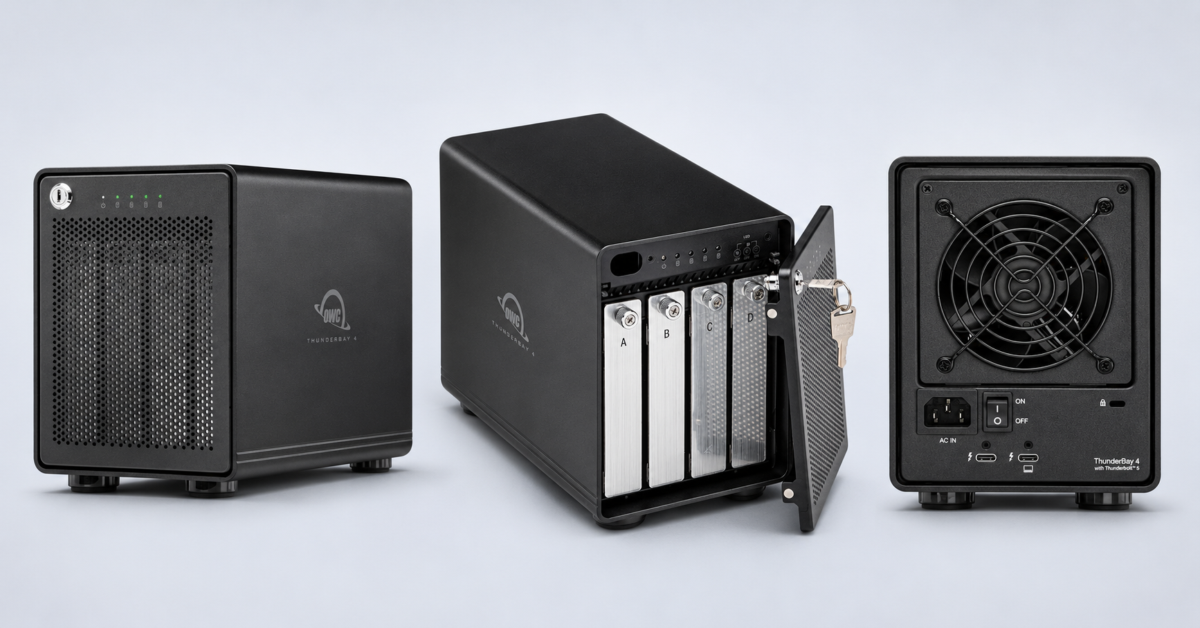
OWC is giving its ThunderBay 4 storage system a Thunderbolt-5 upgrade, along with configurations offering up to 128TB of capacity. That is a 33 percent increase in maximum capacity, providing more room for photographers, video editors, and production teams whose files keep getting bigger.
However, there is a detail worth understanding before getting too excited about that faster connection. This is still a four-bay SATA storage system, and adding Thunderbolt-5 does not turn the drives inside into high-speed NVMe SSDs.
The updated OWC ThunderBay 4 accepts 3.5-inch and 2.5-inch SATA hard drives or SATA SSDs. The internal drive interface is SATA 6Gb/s, while Thunderbolt-5 handles the connection between the enclosure and your computer. There are no M.2 NVMe slots here.
That makes the product particularly relevant to people who need large amounts of storage in one enclosure. Four bays provide a way to consolidate a collection of external drives, and buyers can choose an empty enclosure or a system supplied with drives.
OWC claims real-world speeds of up to 1268MB/s with hard drives and up to 1703MB/s with SATA SSDs. Its product page identifies RAID 0 as the configuration behind the maximum SSD performance figure, which matters because the preconfigured systems ship in RAID 5.
Those numbers are manufacturer claims, and I have not independently tested them. Buyers should not assume that a RAID 5 system will deliver the same performance as the advertised RAID 0 configuration, since the RAID level, installed drives, computer, and workload all affect results.
So, does Thunderbolt-5 actually matter here? It has a practical role, but the advertised storage speeds do not require its full bandwidth. Based on those figures, the new connection alone is not a compelling reason to expect a major improvement in transfers from the four internal SATA drives.
The more interesting benefit is downstream connectivity. The enclosure includes two Thunderbolt-5 ports, with one connecting to the computer and the other available for daisy chaining additional devices. OWC says users can connect up to five additional Thunderbolt or USB4 devices through the downstream connection.
On a compatible Thunderbolt-5 computer, that gives the chain more shared bandwidth for additional equipment. Someone using the ThunderBay alongside other fast storage could find that useful, even though the SATA array itself cannot take full advantage of the connection. For someone connecting only this enclosure, the benefit is less compelling.
The aluminum enclosure retains the four-bay approach that has defined ThunderBay 4 for more than a decade. OWC is updating an established storage format rather than changing the kinds of drives it accommodates, which is useful context for anyone comparing it with newer NVMe-based products.
Preconfigured systems arrive set up in RAID 5, providing fault tolerance for a single drive failure. OWC SoftRAID 9 handles setup and continuous drive health monitoring, helping users keep track of the drives holding their projects.
RAID protection still needs to be paired with a separate backup. Surviving a failed drive is useful, but that protection does not cover every way files can be lost, including accidental deletion or theft of the enclosure.
The 128TB headline also needs context. RAID 5 reserves capacity for parity, so buyers should check the usable storage of their selected configuration instead of assuming the full advertised drive capacity will be available for files.
OWC is also promoting Strada integration for remote collaboration. The company says remote team members can browse, preview, and edit ThunderBay media without first uploading it to cloud storage, potentially reducing the need to duplicate large media libraries.
The updated ThunderBay 4 is available to buy now, with shipments expected to begin next week. Pricing starts at $549.99 for the empty 0TB enclosure, while preconfigured systems start at $1,499.99. The latter is the starting price for the configured lineup, not the price of the 128TB model.
For creators who need substantial capacity and flexible connectivity, this looks like a practical update. Just keep the Thunderbolt-5 branding in perspective. The connection is faster, but this remains a SATA storage array, and that should guide expectations about what it can deliver.
Support independent tech journalism
NERDS.xyz is independently owned and operated. If you enjoy my coverage of Linux, AI, hardware, cybersecurity, and tech culture, consider supporting the site on Ko-fi.
Support NERDS.xyz