
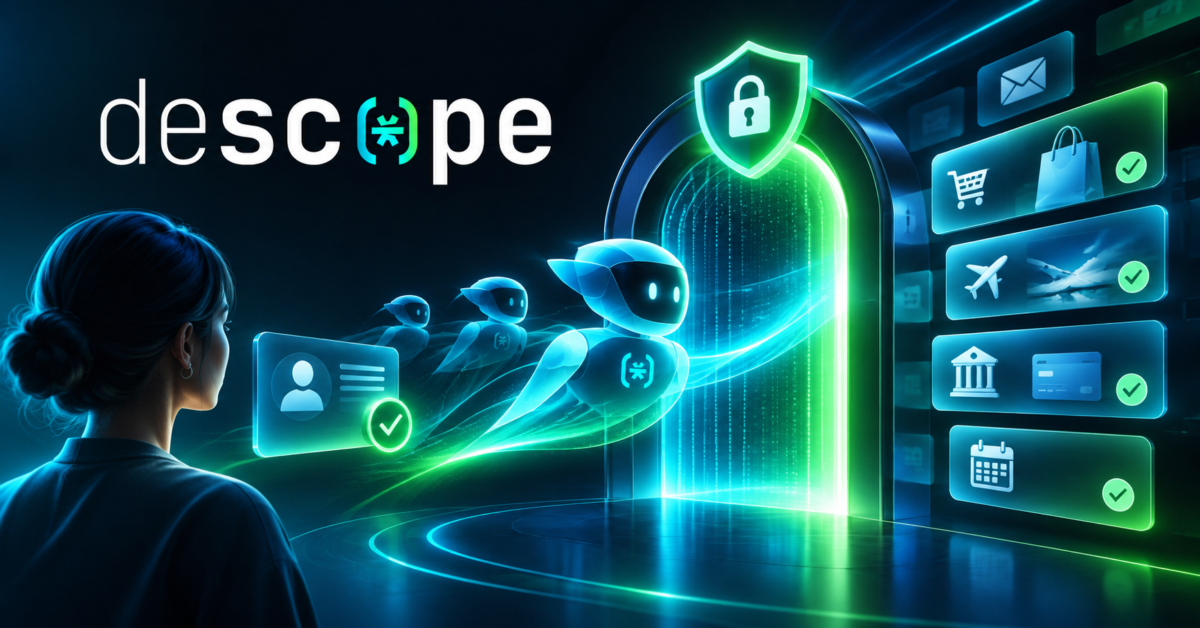
AI assistants are becoming increasingly capable of doing things that once required our personal attention. They can research products, compare prices, and help plan trips. The next step is letting them complete those tasks without us sitting in front of a screen. Unfortunately, that creates a rather serious security problem.
What happens when an AI agent needs access to your online accounts? Giving it your password seems like a terrible idea, particularly when that account contains payment information, personal details, or sensitive records. Yet many websites were never designed to accommodate software acting on behalf of a customer.
Descope believes it has a solution. The company has announced Envoy, a set of identity capabilities designed to give personal AI agents legitimate access to consumer services without forcing them to pretend they are human.
The idea is relatively straightforward. Instead of sharing your login credentials with an AI assistant, you could authorize it to perform specific activities. A business would recognize the agent as a separate entity, understand whose behalf it is acting on, and enforce limits on what it can accomplish.
Consider an AI shopping assistant. You might trust it to search for a new television, compare prices, and purchase a particular model within your budget. That does not mean it should have permission to change your password, update your address, or modify the credit card associated with your account.
Envoy is designed to make those restrictions possible. Businesses can assign detailed permissions and determine how long an agent should retain access. They can also revoke that access without forcing the actual customer to sign out.
There is another potentially useful safeguard. Descope supports approval requests that happen outside the agent’s normal interaction with a website, allowing customers to authorize sensitive transactions directly from their phones.
For example, an AI assistant could search for airline tickets overnight and identify a suitable flight. Rather than immediately spending hundreds of dollars, it could hold the fare and request your approval before completing the purchase. You would see the airline, schedule, and total price before deciding whether to proceed.
I find that approach considerably more appealing than allowing an AI assistant to spend money whenever it believes it has found a good deal. Artificial intelligence can be useful, but I am not particularly interested in giving it unrestricted access to my wallet.
Behind the scenes, Envoy supports the Personal Agent Protocol, also known as Poppy. Developed by Meta and Sierra, the emerging specification provides a standardized way for personal agents to identify themselves, establish authenticated sessions, and interact with participating services.
Descope handles technical requirements such as agent discovery, cryptographically bound session tokens, and granular authorization. It also supports mechanisms for obtaining customer approval before sensitive operations, allowing developers to adopt these features without implementing every part of the evolving protocol themselves.
“Every login page on the internet was built on the assumption that a person is on the other side, but that assumption no longer holds true,” said Slavik Markovich, co-founder and CEO of Descope.
He argues that websites currently face two unappealing options when AI agents arrive. They can block automated access entirely or allow software to log in using a customer’s credentials. Neither provides a particularly satisfying foundation for a future in which consumers increasingly rely on autonomous assistants.
Descope already has some recognizable companies participating in the initiative. GoFundMe, You.com, GoodRx, and Composio are among the launch and design partners helping refine Envoy over the coming months.
The involvement of GoFundMe is particularly interesting because donations involve real money and considerable trust. An AI agent might someday help someone discover worthwhile causes, but actually transferring funds should require clear authorization. GoodRx, meanwhile, sees opportunities for assistants to compare prescription prices and identify pharmacy savings while operating under restricted permissions.
Descope is also introducing a zero-dependency TypeScript SDK for developers building personal agents. It is intended to simplify support for Poppy, including session management and authenticated API requests. The company says its existing Agentic Identity Hub already supports more than 1,000 MCP servers and millions of monthly agent transactions.
Of course, none of this eliminates the risks associated with autonomous AI. An agent could misunderstand a request, follow malicious instructions, or make a questionable decision even when operating within its assigned permissions. Authentication can establish who is acting and what they are allowed to do, but it cannot guarantee good judgment.
There is also no guarantee that businesses will embrace this technology. Supporting personal agents introduces additional responsibilities, and some companies may decide that keeping automated assistants away from customer accounts is the safer choice.
Still, I suspect we are heading toward a world where telling an AI assistant to order groceries or book a hotel becomes perfectly ordinary. If that happens, the authentication systems we use today will need to evolve.
Descope wants Envoy to help make that possible. Whether consumers will feel comfortable granting AI agents access to their accounts is another matter, and perhaps the more important question.
Support independent tech journalism
NERDS.xyz is independently owned and operated. If you enjoy my coverage of Linux, AI, hardware, cybersecurity, and tech culture, consider supporting the site on Ko-fi.
Support NERDS.xyz