ACEMAGIC has introduced the F9A, a compact Windows 11 workstation built around AMD’s Ryzen AI Max+ Pro 495 processor. Its headline feature is support for up to 192 GB of unified memory, giving developers and local AI enthusiasts considerably more room than most mini PCs provide.
The company plans to display the F9A at IFA 2026 in Berlin from September 4 through September 8. ACEMAGIC has not announced pricing or a firm retail availability date, however, so buyers cannot yet determine whether the machine offers reasonable value.
The Ryzen AI Max+ Pro 495 combines 16 Zen 5 CPU cores and 32 threads with Radeon 8065S integrated graphics. ACEMAGIC lists a maximum boost clock of 5.1 GHz for the F9A, although AMD’s specifications say the processor can reach 5.2 GHz.
The Radeon 8065S uses AMD’s RDNA 3.5 architecture and includes 40 compute units running at up to 3 GHz. A dedicated XDNA 2 NPU delivers up to 55 TOPS, while ACEMAGIC advertises 131 TOPS across the CPU, GPU, and NPU.
That combined figure sounds impressive, but it should not be treated as a simple measure of real-world AI performance. Results will depend on software support, memory bandwidth, quantization, context length, and whether a workload can effectively use each part of the processor.
The memory is the real attraction
The most interesting part of the ACEMAGIC F9A is its LPDDR5X-8533 memory running across a 256-bit bus. Because the CPU, GPU, and NPU share the same pool, graphics and AI workloads can access far more memory than they could with a typical integrated GPU.
Memory capacity can determine whether a large language model runs locally at all. Systems with 32 GB or 64 GB may handle smaller models comfortably, but larger quantized models and longer context windows can quickly consume far more RAM.
ACEMAGIC says it tested the F9A running the DeepSeek V4 Flash 284B model locally. The company does not provide detailed performance results, so the claim only shows that the model can run in some form. It does not reveal whether the resulting token speed would be comfortable for daily use.
Developers running several virtual machines, containers, databases, or development tools could also benefit from the unusually large memory ceiling. Independent testing will be needed to determine how the small computer performs during extended CPU and GPU workloads.
Storage and external expansion
The F9A includes two PCIe 4.0 NVMe SSD slots with support for RAID 0 and RAID 1. Users can prioritize performance, redundancy, or separate storage for Windows, applications, media, and model files.
An OCuLink connection provides PCIe 4.0 x4 connectivity for compatible external graphics hardware. This gives owners an upgrade path if the integrated GPU is not fast enough, although adding an external graphics enclosure reduces the space-saving appeal of a mini PC.
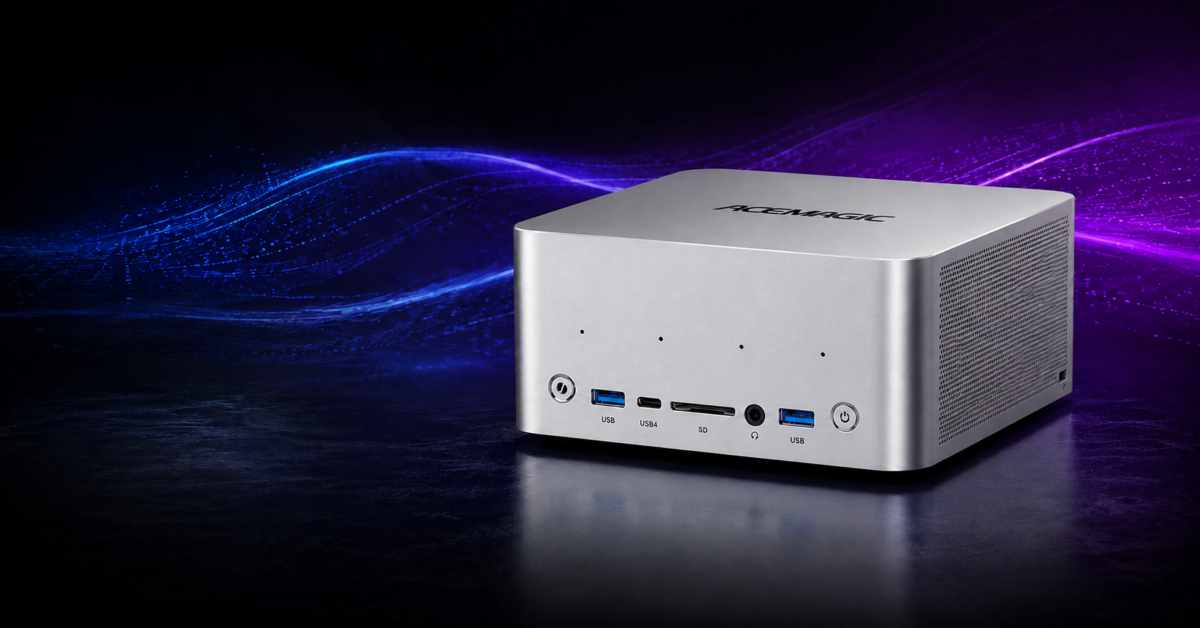
Other connections include two 40 Gbps USB4 Type-C ports, three USB-A 3.2 Gen 2 ports, HDMI 2.1, DisplayPort, and a 3.5 mm audio jack. Wireless connectivity consists of Wi-Fi 7 and Bluetooth 5.4, while two 2.5GbE Ethernet ports should appeal to home lab users and anyone working with high-speed network storage.
Everything fits inside a two liter chassis
The CNC-machined aluminum enclosure measures 158.5 x 158.5 x 81.5 mm and occupies approximately two liters. ACEMAGIC includes a VESA mount, allowing the computer to sit behind a compatible monitor or under a desk.
Cooling consists of five copper heat pipes, a copper base, a turbine-style fan, and a large air intake. Those specifications look capable on paper, but cooling and noise are common concerns with compact workstations. Long benchmarks will be more informative than short tests that end before heat builds up.
The computer also includes a four-microphone array, two 2-watt speakers, and a dedicated Copilot key. These extras may help with calls and voice applications, but they probably will not influence someone shopping for a high-memory workstation.
ACEMAGIC has squeezed an unusual combination of memory, processing power, and connectivity into a small enclosure. Unfortunately, without pricing, final configurations, or independent benchmarks, the F9A remains difficult to judge. It could become an interesting local AI workstation, but its appeal will ultimately depend on performance and cost.
Support independent tech journalism
NERDS.xyz is independently owned and operated. If you enjoy my coverage of Linux, AI, hardware, cybersecurity, and tech culture, consider supporting the site on Ko-fi.
Support NERDS.xyz