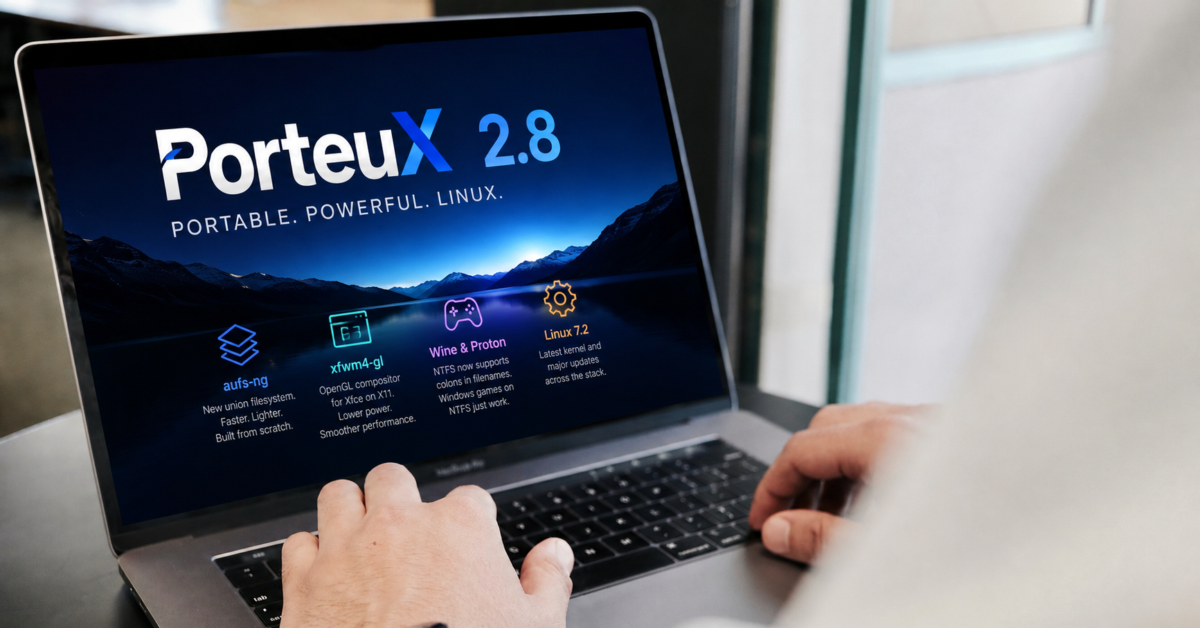
PorteuX 2.8 is now available, and this is a surprisingly substantial update for the Slackware-based portable Linux distribution. There are plenty of the usual package updates and bug fixes, but the real story is that the PorteuX developers have created two major components of their own.
Those projects are aufs-ng, a new union filesystem that replaces aufs, and xfwm4-gl, an Xfce window manager fork that brings OpenGL compositing to X11. Gamers get some good news too, as Wine and Proton can now work on NTFS partitions thanks to a change in filename handling.
The biggest change under the hood is aufs-ng. PorteuX has depended on aufs since the distribution’s beginning, but the developers have now written their own union filesystem from scratch and made it the default.
Importantly, aufs-ng retains the same on-disk format and mount command grammar as aufs. Existing PorteuX functionality should therefore continue working without users having to learn a different way of mounting or managing the filesystem.
The difference is what is happening underneath. PorteuX says aufs-ng consists of roughly 5,000 lines of code compared with about 28,000 for aufs. It uses the Linux kernel’s modern I/O passthrough, reducing filesystem-wide locking, while copy-up operations use in-kernel splice instead of page-by-page buffering.
PorteuX also says aufs-ng tracks only inodes and uses roughly one-third of the memory of aufs once the system is warmed up. Those are impressive claims, particularly for a project so central to how PorteuX operates, although wider use should give us a better idea of how the new filesystem behaves across different hardware and workloads.
The second in-house project is xfwm4-gl. This is a fork of Xfce’s xfwm4 window manager that adds OpenGL compositing when running X11. XRender remains available as an automatic fallback.
According to PorteuX, xfwm4-gl consumes around one-third less power than XRender while delivering roughly 10 percent more frames per second to applications. It also adds adaptive vsync, automatically suspends compositing when an application goes full screen, introduces inactive button highlighting in window themes, and includes numerous fixes.
PorteuX 2.8 removes the regular xfwm4 from its Xfce edition and replaces it with xfwm4-gl as the default window manager and compositor. This applies to X11, of course. Xfce users choosing Wayland will continue to get labwc as the default.
Gamers may find the NTFS change just as interesting. The NTFS driver can now accept colons in filenames, which means Wine and Proton can work with games stored on NTFS partitions. That could be particularly useful on dual-boot systems where Windows and Linux share access to a game library.
NTFS handling has also been changed so that PorteuX can use both the ntfs and ntfs3 drivers, with ntfs preferred when both are available. The release fixes NTFS devices not ejecting properly as well.
There are plenty of upstream updates. PorteuX 2.8 moves to Linux kernel 7.2, NVIDIA driver 610.57.04, GCC 16.2.0, FFmpeg 9.0.1, and Mesa 26.2.1. Cinnamon has been updated to 6.6.9, COSMIC to 1.6.0, GNOME to 50.4, and KDE Plasma to 6.7.4.
The move to GCC 16 introduced a compatibility problem for some software, so PorteuX now includes gcc15-compat. It restores a C++ symbol removed in GCC 16 and should fix applications such as VirtualBox that stopped working after the compiler upgrade. VirtualBox shared-folder support has also been enabled in the kernel, while dead code elimination is now enabled there as well.
PorteuX 2.8 makes several changes to its desktop environments. COSMIC gains cosmic-monitor, which replaces gnome-system-monitor. GNOME receives gnome-session-sysvinit along with a patch to disable systemd, while KDE gains appstream-qt, qtkeychain, and zint.
There are fixes for the Wi-Fi password dialog not appearing in GNOME and missing test sounds in GNOME and KDE Plasma. LXDE screen locking has been corrected so it locks the current session rather than opening another one, while Wayland and X11 session detection has been fixed in LXQt. PorteuX also fixed the Xfce compositor bypass hint, which previously did not work for normal windows.
The PorteuX App Store gets quite a bit of attention in 2.8. Package downloads have been fixed, along with incorrect version detection and failures that were sometimes reported as successful. The developers also addressed scripts being written before downloads completed and a progress window that could remain open afterward.
AppImages downloaded through the App Store now get a corrected desktop entry so they can receive files and display their icons properly. The Flatpak wrapper has also been fixed so that the storage path can appear in any position.
Elsewhere, PorteuX fixed Transmission crashes, xpdf failing to read its configuration file, and the timezone tool crashing when /etc/localtime points to a broken symlink. Graphical applications launched as root should now receive XDG_RUNTIME_DIR, and the version displayed in the login-screen message has been corrected. A typo in the documentation for the mopt cheatcode has been fixed too.
There are some less visible performance and size improvements. FFmpeg and PipeWire startup have been improved, build and linker flags have been further optimized, and stripping has been improved across numerous modules.
The initrd received a more substantial cleanup. All of its binaries have been updated, while the separate uClibc library has been removed and is now embedded statically. PorteuX says this makes the initrd around 30 percent smaller. A new bootlog cheatcode can save everything printed by the initrd during boot, which should make troubleshooting easier.
There is an interesting filesystem behavior change too. Deleting a file and then deleting its whiteout will now cause the original file to return, bringing the behavior in line with what users would probably expect from PorteuX’s layered filesystem model.
The developers have done some package cleanup as well. BlueZ daemon auto-start has been removed, opus has been dropped because libopus is sufficient and considered less troublesome, and faac and faad2 are gone because FFmpeg can handle AAC without them.
Finally, PorteuX has a new place hosting its files. Slackware.uk is now hosting the distribution, giving the project another piece of infrastructure as it continues to develop its increasingly customized take on Slackware Linux.
There is a lot packed into PorteuX 2.8, but aufs-ng and xfwm4-gl are what make this release particularly interesting. Instead of simply pulling newer components from upstream, the PorteuX developers are replacing important pieces with projects they control themselves.
That can bring real advantages, especially if the claimed memory, performance, and power improvements hold up. It also means more code for a relatively small project to maintain. Aufs-ng in particular sits in a pretty important place for PorteuX, so it will be worth watching how it holds up as more users put version 2.8 through its paces.
Support independent tech journalism
NERDS.xyz is independently owned and operated. If you enjoy my coverage of Linux, AI, hardware, cybersecurity, and tech culture, consider supporting the site on Ko-fi.
Support NERDS.xyz