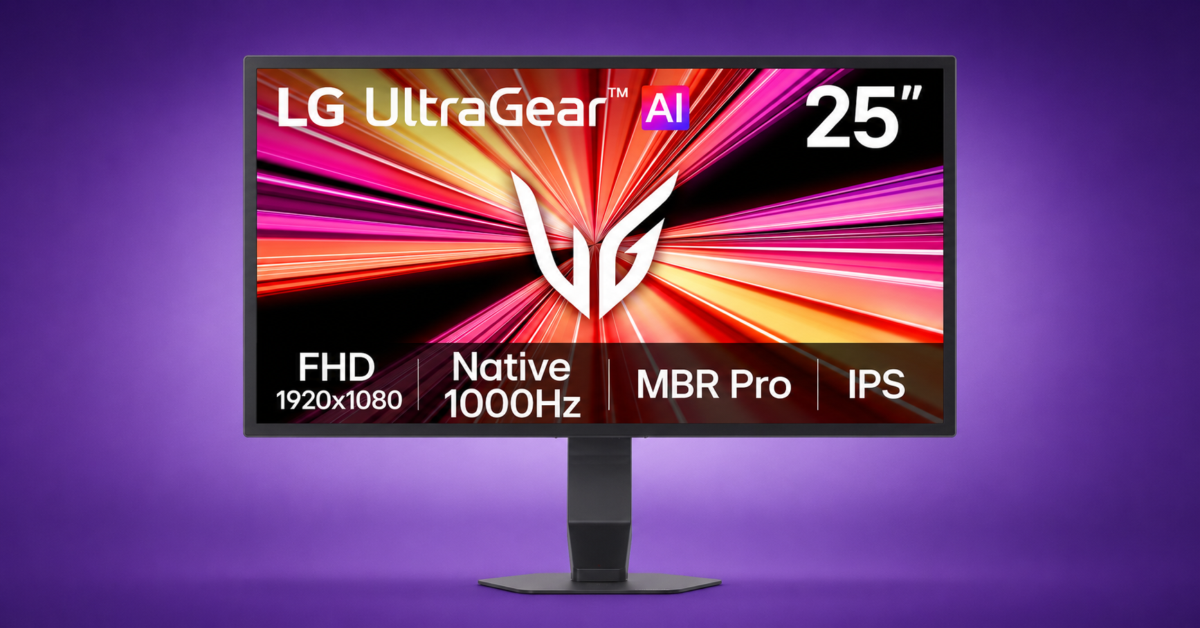
How many frames per second are enough? Apparently, 500Hz and 600Hz are no longer sufficient for the most demanding competitive gamers. LG is pushing things considerably further with the UltraGear 25G590B, a 25-inch gaming monitor capable of running at a native 1,000Hz refresh rate. Yes, really.
LG calls the 25G590B the world’s first Full HD gaming monitor with a native 1,000Hz refresh rate. More importantly, this is not a prototype being shown behind glass at a trade show. LG has announced U.S. pricing and availability, and the monitor coats $999.99 (buy it here). Yeah, that is nearly $1,000 for a 25-inch 1080p monitor.
Of course, looking at the 25G590B as a normal computer monitor misses the point. LG designed this thing primarily for competitive gaming, particularly fast-paced first-person shooters where every millisecond can matter. The relatively small 25-inch screen is intentional too, as esports players often prefer displays that allow them to see essentially the entire playing area without moving their eyes or head much.
The headline specification is that native 1000Hz refresh rate at 1920 x 1080 resolution. LG emphasizes the word “native” because the monitor does not rely on a special lower-resolution mode or require users to toggle between display modes to reach its maximum refresh rate. If your computer can actually generate enough frames, the display is designed to operate at 1,000Hz at Full HD resolution.
That last part is important. Buying a 1000Hz monitor does not magically make games run at 1,000 frames per second. Reaching frame rates anywhere close to the monitor’s ceiling will require extremely powerful hardware, appropriately lightweight competitive games, and settings chosen with performance rather than visual quality in mind.
LG includes Dynamic Action Sync to reduce input lag and Motion Blur Reduction Pro to improve the visibility of moving objects. The monitor is also Nvidia G-SYNC Compatible and supports AMD FreeSync Premium. An IPS panel with a low-reflection film should help with viewing consistency and glare.
There is even an integrated FPS counter, which seems particularly appropriate for a monitor where owners will probably spend a lot of time obsessing over whether their computers are producing enough frames to justify what they just bought.
LG has not ignored ergonomics either. The stand supports height, swivel, and tilt adjustments, with calibration markings intended to make it easier for players to reproduce a preferred position. The compact stand is designed to leave more desk space available for large mouse movements, while a built-in headset hook provides a convenient place to store headphones. UltraGear Emblem lighting adds customizable ambient lighting to the setup.
And because seemingly no piece of consumer electronics can escape AI in 2026, the 25G590B has that too. LG says its on-device AI Scene Optimization can automatically adjust picture settings based on displayed content. AI Sound is designed to improve spatial audio and in-game communication when the monitor is used with a compatible headset.
Those features are fine, but nobody is spending $999.99 on this monitor because of AI. The reason to buy the 25G590B is right there in the specification sheet: 1,000Hz.
For most PC gamers, this monitor will make very little financial sense. You can buy a larger display with a much higher resolution for less money, and even serious gamers may struggle to notice meaningful improvements as refresh rates climb this high. The audience here is competitive players who prioritize motion clarity, latency, and frame rate above resolution, screen size, and practically everything else.
That also makes the 25G590B an interesting glimpse at where gaming displays are heading. It wasn’t that long ago that 144Hz felt exceptionally fast. Then 240Hz became increasingly common, followed by 360Hz, 500Hz, and beyond. Now LG is putting a native 1,000Hz monitor on sale in the United States.
The bigger question is whether human eyes and reflexes can continue benefiting enough from these increasingly extreme refresh rates to justify the cost. At $1,000 for a 25-inch 1080p display, LG is certainly asking competitive gamers to put that theory to an expensive test.
As an Amazon Associate I earn from qualifying purchases. Some links in this article may be affiliate links. If you click one and make a purchase, I may receive a small commission at no extra cost to you. This helps support NERDS.xyz.
Support independent tech journalism
NERDS.xyz is independently owned and operated. If you enjoy my coverage of Linux, AI, hardware, cybersecurity, and tech culture, consider supporting the site on Ko-fi.
Support NERDS.xyz