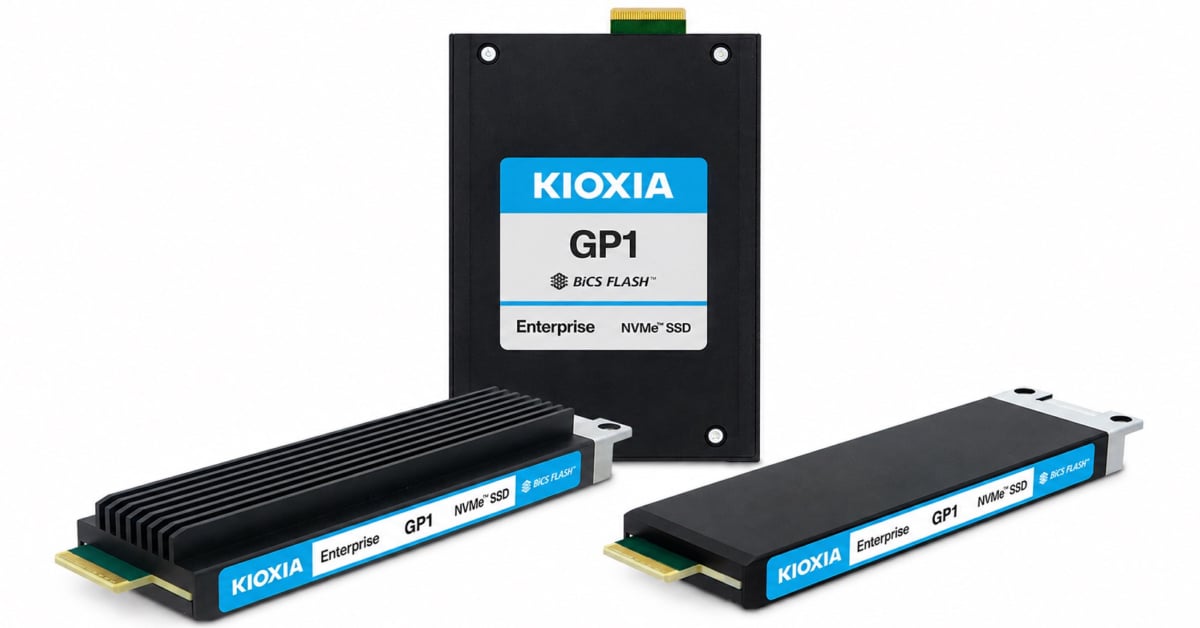
Just days after introducing its high-capacity CM10 enterprise SSDs, Kioxia has unveiled a very different kind of PCIe 6.0 drive. While the CM10 Series focuses on delivering large amounts of fast enterprise storage, the new GP1 Series is built for something much more specialized: helping GPUs access data with memory-like performance for AI workloads.
Instead of relying on conventional TLC NAND, the Kioxia GP1 Series uses the company’s second-generation XL-FLASH memory, a lower-latency technology designed to dramatically reduce access times. The result is an SSD capable of delivering up to 10 million random read IOPS using tiny 512-byte block sizes, making it less about storing massive datasets and more about feeding GPUs the data they need as quickly as possible.
The company says the GP1 Series is optimized for GPU direct access and emerging AI storage architectures that extend High Bandwidth Memory (HBM) with flash. Since HBM is both expensive and limited in capacity, using ultra-fast flash as another memory tier could allow AI systems to work with much larger datasets without dramatically increasing hardware costs. It could also help improve GPU utilization by reducing the time accelerators spend waiting for data.
Unlike the recently announced CM10 Series, which uses BiCS FLASH TLC NAND and is designed as a traditional enterprise SSD for AI servers and data centers, the GP1 is purpose-built for extremely low latency. It is available in E3.S and E1.S form factors, supports PCIe 6.0 and NVMe 2.2, and offers endurance of up to 50 drive writes per day, far exceeding what most conventional enterprise SSDs are designed to handle.
Liquid cooling also makes another appearance. Certain GP1 models support cold-plate liquid cooling, although every version can still operate in standard air-cooled systems. As AI servers continue to consume more power and generate more heat, it is becoming increasingly common to see storage devices designed with advanced cooling options in mind.
Perhaps the boldest claim is Kioxia’s long-term vision. While the GP1 Series delivers up to 10 million random read IOPS today, the company says the underlying architecture is intended to scale toward 100 million IOPS in future generations. That is an eye-catching number, although reaching it will depend on more than just the SSD itself.
Evaluation samples of the GP1 Series will be available to select customers by the end of 2026, making it clear that this is not a product aimed at consumers or even most enterprise deployments. Instead, it is targeting hyperscalers, AI cloud providers, and organizations building the next generation of GPU clusters.
As AI infrastructure evolves, it is becoming increasingly obvious that throwing more GPUs at a problem is not always enough. Memory bandwidth and latency are emerging as major bottlenecks, and Kioxia is betting that ultra-low-latency flash can help bridge the gap.
Support independent tech journalism
NERDS.xyz is independently owned and operated. If you enjoy my coverage of Linux, AI, hardware, cybersecurity, and tech culture, consider supporting the site on Ko-fi.
Support NERDS.xyz