
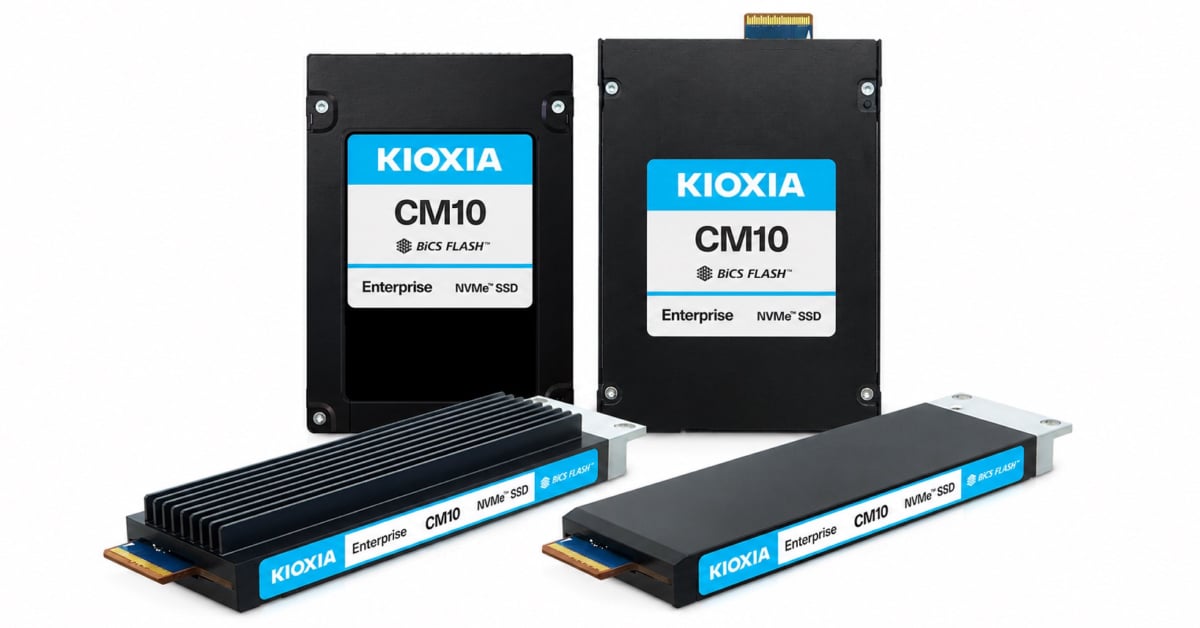
Kioxia has introduced its first PCIe 6.0 enterprise solid-state drives, giving data center operators a new storage option for demanding artificial intelligence workloads.
The company has been moving quickly in this area. Kioxia recently unveiled liquid-cooled PCIe 5.0 SSDs for AI servers, but the new CM10 Series pushes things further with PCIe 6.0 support and newer 332-layer flash memory.
The Kioxia CM10 Series uses the company’s latest BiCS FLASH generation 10 TLC NAND. The drives are designed for AI inference, context caching, enterprise databases, and other applications that need to move large amounts of data quickly.
Kioxia says the CM10 Series can deliver up to 92 percent faster sequential read performance and up to 85 percent faster random read performance than its previous-generation CM9 drives.
Those performance gains could matter as AI systems become larger and more complicated. Modern AI models often need access to enormous datasets, while longer context windows require infrastructure that can quickly store and retrieve cached information.
GPUs may get most of the attention, but storage can still become a bottleneck. A server packed with expensive accelerators will not reach its full potential when data cannot reach those chips fast enough.
The CM10 Series supports NVIDIA CMX, an architecture designed to extend AI memory beyond the limited and costly memory installed directly on GPUs. Instead of keeping everything in GPU memory, systems can use high-speed flash storage to hold context cache data.
This does not make SSD storage as fast as GPU memory, of course. However, it can provide a larger and more affordable layer of storage for information that an AI system may need to access frequently.
Kioxia is also offering direct cold-plate liquid cooling on certain CM10 models. Liquid cooling is available with the E3.S and E1.S 9.5mm form factors, although those drives can still operate in traditional air-cooled servers.
The cooling support is notable because AI hardware produces a tremendous amount of heat. As server racks become denser and power consumption rises, relying entirely on fans and air conditioning becomes more difficult and expensive.
Direct liquid cooling can remove heat closer to the source. It may also allow data center operators to deploy more hardware in a smaller space without running into the same thermal limits.
The CM10 Series will be available in E3.S, E1.S, and 2.5-inch form factors. Capacities range from 1.60TB to 61.44TB, depending on the model and configuration.
Kioxia will offer read-intensive models rated for one drive write per day, along with mixed-use versions rated for three drive writes per day. That gives customers some flexibility when choosing between capacity, endurance, and cost.
The PCIe 6.0 models support NVMe 2.1 and portions of the Open Compute Project Datacenter NVMe SSD Specification v2.7. They also support NVMe Flexible Data Placement, which can help reduce write amplification and improve how data is organized on the drive.
There is one important detail buried in the announcement. The 2.5-inch CM10 model is limited to PCIe 5.0 and uses older BiCS FLASH generation 8 memory. Customers wanting the full PCIe 6.0 and generation 10 experience will need to choose one of the newer form factors.
Security options include self-encrypting drive configurations, SPDM 1.4 attestation, and planned FIPS 140-3 support. Kioxia also says the drives will support post-quantum cryptography recommendations associated with CNSA 2.0.
The post-quantum language may sound premature, but enterprise storage can remain in service for years. Data center customers increasingly want hardware purchased today to account for security threats that could emerge later.
Kioxia is currently sampling the CM10 Series to select customers. The company plans to display the drives at FMS The Future of Memory and Storage in Santa Clara from August 4 through August 6.
Pricing and general availability have not been announced.
PCIe 6.0 should eventually provide much more bandwidth than PCIe 5.0, but peak interface speed is only part of the story. Real-world performance will depend on the drive, server platform, workload, cooling system, and software stack.
Even so, the CM10 Series shows where enterprise storage is heading. SSD makers are no longer selling capacity and benchmark numbers alone. They are now pitching cooling, power efficiency, security, and direct integration with AI infrastructure.
Kioxia appears ready for that transition. The bigger question is how quickly data center operators will move beyond PCIe 5.0 hardware and start paying for PCIe 6.0 storage.
Support independent tech journalism
NERDS.xyz is independently owned and operated. If you enjoy my coverage of Linux, AI, hardware, cybersecurity, and tech culture, consider supporting the site on Ko-fi.
Support NERDS.xyz