
AI servers are getting faster, denser, and much hotter. Kioxia thinks storage needs to evolve alongside them.
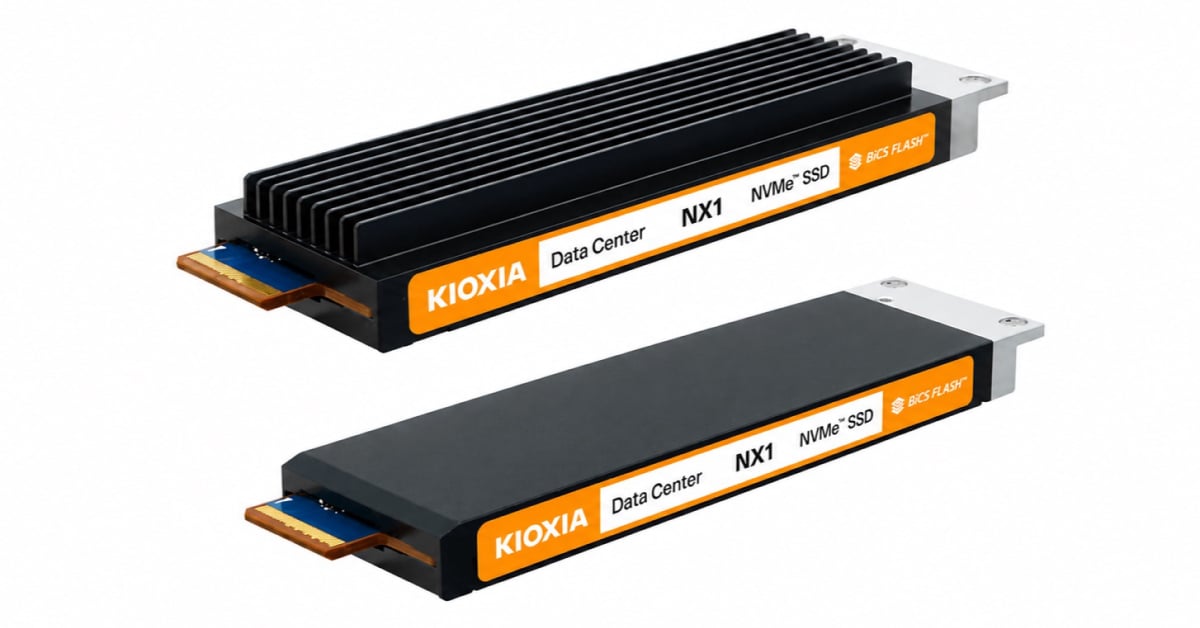
You see, the company has announced its new KIOXIA NX1 Series, a family of E1.S PCIe 5.0 NVMe data center SSDs designed for AI servers and hyperscale environments. The drives are notable not only for their claimed performance gains, but also because they are Kioxia’s first SSDs to support direct liquid cooling.
That cooling support could become increasingly important as data center operators cram more GPUs, processors, and storage into compact server designs. Air cooling can only do so much when nearly every component inside a rack is generating substantial heat.
The NX1 Series will be available in E1.S 9.5 mm and 15 mm form factors. The thinner 9.5 mm model supports both air cooling and direct liquid cooling, while the 15 mm version relies on air cooling.
For direct liquid cooling, the SSD can be used with a cold plate that pulls heat away from the drive. This does not mean liquid flows through the SSD itself, of course, but it allows the drive to become part of a broader liquid-cooled server design.
Kioxia says the NX1 Series is aimed at GPU-enabled servers, cloud providers, and hyperscale data centers. Those are environments where storage performance can become a bottleneck if it fails to keep pace with the processors consuming the data.
Compared with the previous KIOXIA XD8 Series, the company claims the NX1 drives can deliver up to approximately 38 percent higher sequential write performance and up to approximately 20 percent higher random write performance.
Those numbers sound good, although buyers should remember that they are comparisons against Kioxia’s own previous-generation drives. Kioxia has not provided broader comparisons against competing enterprise SSDs from companies such as Samsung, Micron, Solidigm, or Western Digital.
The drives use Kioxia’s eighth-generation BiCS Flash TLC memory and a new controller architecture developed in-house. Bringing controller development under its own roof should give Kioxia tighter control over performance, power consumption, firmware, and future features.
The NX1 Series supports PCIe 5.0 and NVMe 2.0, along with the Open Compute Project Datacenter NVMe SSD 2.6 specification. Kioxia is also including support for NVMe Flexible Data Placement, commonly known as FDP.
FDP is intended to improve how data is placed on an SSD, potentially reducing write amplification and extending drive endurance. That could matter in large data centers, where even relatively small improvements in efficiency can add up across thousands of drives.
Capacities will range from 1.92 TB to 15.36 TB. Kioxia rates the drives for one drive write per day, which positions them primarily for read-intensive workloads rather than the most demanding write-heavy applications.
An optional self-encrypting drive model will also be available with support for the TCG Opal standard, although availability may depend on regional regulations.
The biggest story here may not be the performance numbers. PCIe 5.0 enterprise SSDs are no longer unusual, and every storage company claims its latest generation is faster and more efficient.
The direct liquid cooling support is more interesting because it shows how AI infrastructure is changing the design of components that previously relied almost entirely on airflow. Storage drives may not generate as much heat as GPUs, but in a densely packed AI server, every source of heat matters.
Kioxia is currently sampling the NX1 Series to select hyperscale customers. The company plans to display the drives at FMS The Future of Memory and Storage in Santa Clara from August 4 through August 6.
There is no pricing information yet, and Kioxia has not announced when the drives will enter broader production. That means the NX1 Series is currently more of a preview of Kioxia’s next-generation data center strategy than a product most organizations can immediately order.
Still, liquid-cooled SSD support offers a useful glimpse at where AI server design is heading. As racks become hotter and more crowded, storage may need the same advanced cooling treatment already being applied to CPUs and GPUs.
Support independent tech journalism
NERDS.xyz is independently owned and operated. If you enjoy my coverage of Linux, AI, hardware, cybersecurity, and tech culture, consider supporting the site on Ko-fi.
Support NERDS.xyz