
The AI boom continues to produce enormous amounts of money, and SK hynix may have delivered one of the clearest examples yet.
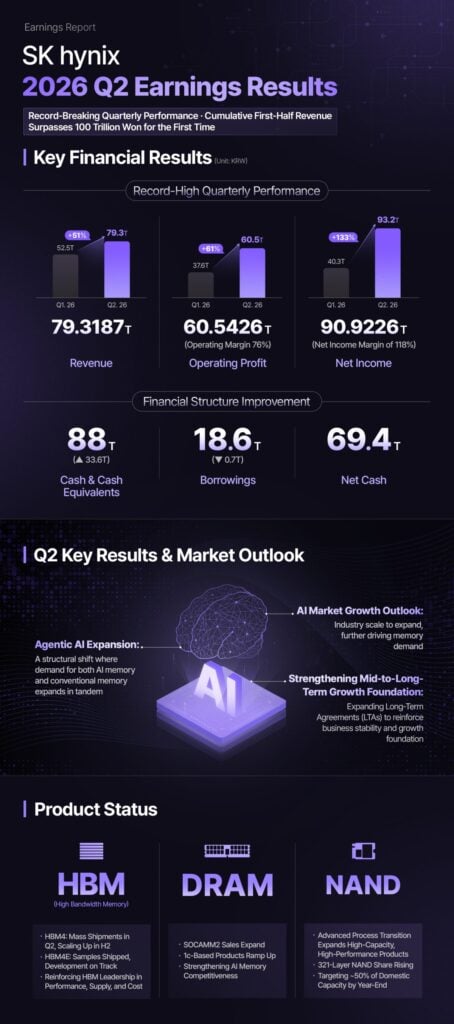
The South Korean memory manufacturer reported revenue of 79.3 trillion won for the second quarter of 2026, an increase of 257 percent from the same period last year. Operating profit reached 60.5 trillion won, up an astonishing 557 percent year over year. That’s absolutely insane.
SK hynix says this was the strongest quarterly performance in its history. Revenue for the first half of 2026 also surpassed 100 trillion won for the first time. Those are not the numbers of an industry waiting for the AI bubble to burst.
Ed Zitron, one of the loudest and most entertaining anti-AI voices, may have a difficult time pooh-poohing this news. He can certainly argue that AI companies are spending too much money, that many AI services lack sustainable business models, or that current valuations are absurd. Some of those criticisms are entirely fair.
What is harder to dismiss is the money flowing through the companies supplying the infrastructure.
SK hynix is not selling vague promises about an artificial general intelligence arriving next year. It is selling actual memory chips to customers building actual servers. Those customers apparently want far more memory than the company can currently produce, and they are willing to pay handsomely for it.
High Bandwidth Memory, better known as HBM, played a central role in the quarter. HBM sits alongside AI accelerators and helps move enormous amounts of data quickly enough to keep those expensive processors busy. As AI models grow and inference workloads spread, demand for this specialized memory continues to climb.
SK hynix also benefited from stronger sales of server DRAM, enterprise solid-state drives, and other higher-margin products. Prices increased across both DRAM and NAND flash memory during the quarter, giving the company another substantial boost.
The company says HBM4 has reached the operating speeds requested by customers while delivering competitive power efficiency and manufacturing costs. Mass shipments began during the second quarter, with production scheduled to increase during the second half of 2026.
SK hynix also completed sample shipments of HBM4E during the first half of the year. That product will target the next generation of AI accelerators, where memory bandwidth and energy consumption will become even more important.
The company is not simply hoping demand will continue. It has finalized long-term agreements with around 10 customers, including what it describes as key strategic partners. Additional discussions are underway with other large customers.
Multi-year agreements should give SK hynix greater visibility into future demand while helping customers reserve limited production capacity. They also suggest that major technology companies do not view their AI infrastructure spending as a brief experiment.
SK hynix believes AI demand is expanding beyond model training. Agentic AI systems, which are designed to perform complicated tasks with less direct human involvement, could create additional demand for memory in servers, PCs, and other devices.
The company argues that this is also benefiting conventional memory. AI infrastructure consumes huge quantities of specialized products, but the surrounding servers, storage systems, networking equipment, and client devices still need ordinary DRAM and NAND.
SK hynix ended the quarter with 88 trillion won in cash and cash equivalents, an increase of 33.6 trillion won from the previous quarter. Total debt declined slightly to 18.6 trillion won, leaving the company with a reported net cash position of 69.4 trillion won.
There is one figure that deserves additional scrutiny. SK hynix reported net profit of 93.9 trillion won, which exceeded its quarterly revenue and produced a net margin of 118 percent. That usually points to substantial non-operating income, accounting adjustments, or other one-time factors. The announcement does not provide enough detail to explain the figure, so it should not be treated as ordinary operating profitability.
The underlying business results are impressive enough without leaning on that unusual net-income number.
To meet rising demand, SK hynix is accelerating production at its M15X facility and preparing to expand capacity following the planned opening of the first Yongin cleanroom in early 2027. It is also planning investments in advanced packaging, additional NAND manufacturing, and a new semiconductor cluster.
The company says these projects will move forward in stages based on customer demand and investment efficiency. That discipline will matter. Semiconductor manufacturers have repeatedly damaged their own profitability by building too much capacity near the top of a market cycle.
AI spending could eventually slow, and the memory business remains notoriously cyclical. Customers may also find ways to reduce memory requirements or delay infrastructure purchases if AI services fail to generate enough revenue.
For now, however, the demand is real, the chips are shipping, and SK hynix is making an extraordinary amount of money.
AI skeptics can keep arguing about whether chatbots are useful or whether Silicon Valley has lost its mind. SK hynix is busy counting the cash.
Support independent tech journalism
NERDS.xyz is independently owned and operated. If you enjoy my coverage of Linux, AI, hardware, cybersecurity, and tech culture, consider supporting the site on Ko-fi.
Support NERDS.xyz