
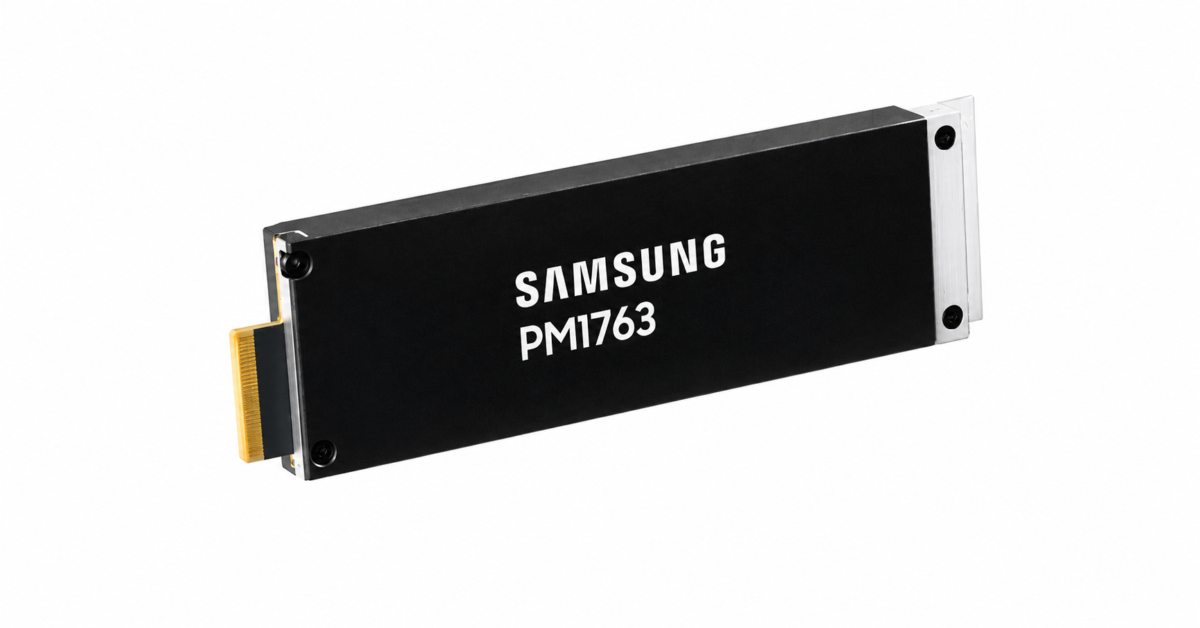
If there’s one thing AI servers can’t get enough of, it’s data. Faster processors and accelerators don’t mean much if storage can’t keep up. That’s where Samsung says its new PM1763 enterprise SSD comes in.
Samsung has announced that it has begun mass production of the PM1763, a PCIe 6.0 enterprise SSD designed for AI and high performance computing (HPC) servers. While this isn’t a drive you’ll be dropping into your desktop anytime soon, it offers a glimpse at where enterprise storage is headed as AI models continue to grow in size.
The PM1763 combines Samsung’s ninth-generation V-NAND with a newly developed 4nm controller. It will be offered in 4TB, 8TB, and 16TB capacities, with the flagship 16TB model delivering sequential read speeds of up to 28,400MB/s and write speeds of up to 21,900MB/s. According to Samsung, that’s more than twice the performance of the previous-generation PM1753.
To put those numbers into perspective, Samsung says the drive can transfer a 40GB large language model in about 1.4 seconds. In AI environments, moving data that quickly can help reduce bottlenecks between storage, processors, and AI accelerators, ultimately improving overall system performance.
Samsung also focused on efficiency. The company says the PM1763 delivers more than 1.8 times better power efficiency than its predecessor, which could help reduce power consumption in large datacenters where hundreds or even thousands of SSDs may be deployed.
Another interesting feature is support for post-quantum cryptography, which is designed to help protect data from future quantum computing attacks. The drive also supports TEE Device Interface Security Protocol (TDISP), adding another layer of protection for data moving through virtualized server environments.
The PM1763 is also optimized for direct-to-chip liquid-cooled servers, allowing it to maintain peak performance during demanding AI workloads without excessive heat becoming a limiting factor.
You probably won’t find the PM1763 on Amazon or in your next gaming PC, but that’s totally okay. Enterprise hardware like this often gives us an early look at technologies that eventually trickle down to consumer products. Even if this SSD never leaves the datacenter, it’s an impressive reminder that storage is becoming just as important as GPUs in the race to build faster AI infrastructure.
Support independent tech journalism
NERDS.xyz is independently owned and operated. If you enjoy my coverage of Linux, AI, hardware, cybersecurity, and tech culture, consider supporting the site on Ko-fi.
Support NERDS.xyz