
For years, SSD marketing has mostly revolved around the same talking points. Faster game loading. Bigger benchmark numbers. Better sequential speeds. Folks shopping for storage have been conditioned to focus on giant read and write numbers while random performance usually gets buried somewhere deep in a spec sheet.
Now, according to Silicon Motion, the rise of AI PCs could start changing that.
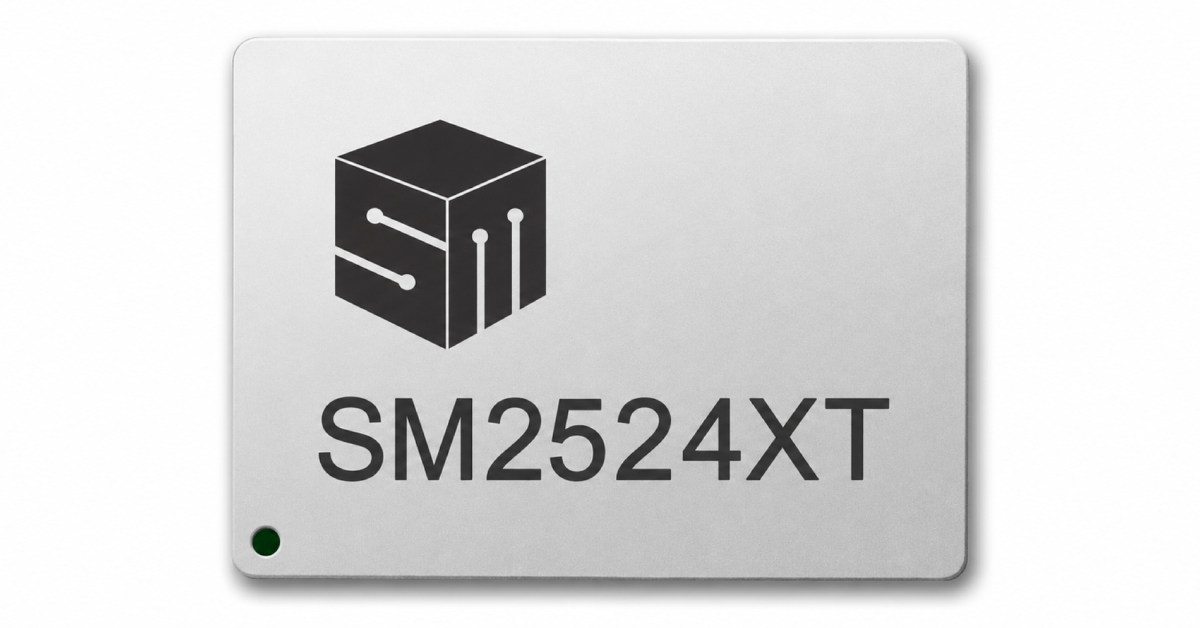
The company has announced the SM2524XT, a new PCIe Gen5 DRAMless SSD controller designed specifically for AI inference workloads and something called KV Cache operations. While that might sound like typical AI buzzword soup at first glance, there is actually an interesting technical argument underneath all the marketing.
Traditional consumer workloads, such as launching apps, copying files, or loading games, tend to reward high sequential throughput. AI workloads are different. Running local large language models generates a constant flood of fragmented random reads and writes, especially when models repeatedly access cached token data during inference sessions.
That is where Silicon Motion claims its new controller shines.
The SM2524XT uses a four-core architecture built on TSMC’s 6nm process and supports PCIe Gen5 x4 connectivity with NAND speeds up to 4800 MT/s. Silicon Motion says the controller can hit sequential read speeds up to 14GB/s while delivering as much as 2.5 million random IOPS. More importantly, the company says performance remains stable during sustained AI workloads rather than collapsing once thermals rise or cache behavior changes.
The DRAMless aspect is especially interesting here.
Among PC enthusiasts, DRAMless SSDs have developed a reputation as budget hardware typically associated with lower-end drives. In many cases, that reputation is deserved. Some DRAMless SSDs can feel sluggish under heavy workloads compared to models with dedicated onboard cache memory.
Silicon Motion appears to be betting that modern controller design can compensate for at least some of those disadvantages. The company says technologies such as Separated Command Address architecture, advanced FTL scheduling, and NANDXtend LDPC error correction help maintain low latency during AI-heavy storage activity.
Whether average users will notice any of this in the near future is another question entirely.
Right now, most so-called AI PCs are still being used for the same mundane tasks people have always done on laptops. Email. Web browsing. Office work. Streaming video. Local AI inference remains fairly niche outside enthusiasts running tools like Ollama or experimenting with local LLMs on Linux desktops.
Still, the industry clearly believes local AI workloads are going to grow. If that happens, storage behavior may start mattering in ways consumers have not really considered before. Suddenly, raw sequential speed numbers may not tell the whole story anymore.
And if Silicon Motion is right, the next big SSD battle might not be about loading games faster. It could be about feeding AI models data with as little latency as possible.
Support independent tech journalism
NERDS.xyz is independently owned and operated. If you enjoy my coverage of Linux, AI, hardware, cybersecurity, and tech culture, consider supporting the site on Ko-fi.
Support NERDS.xyz