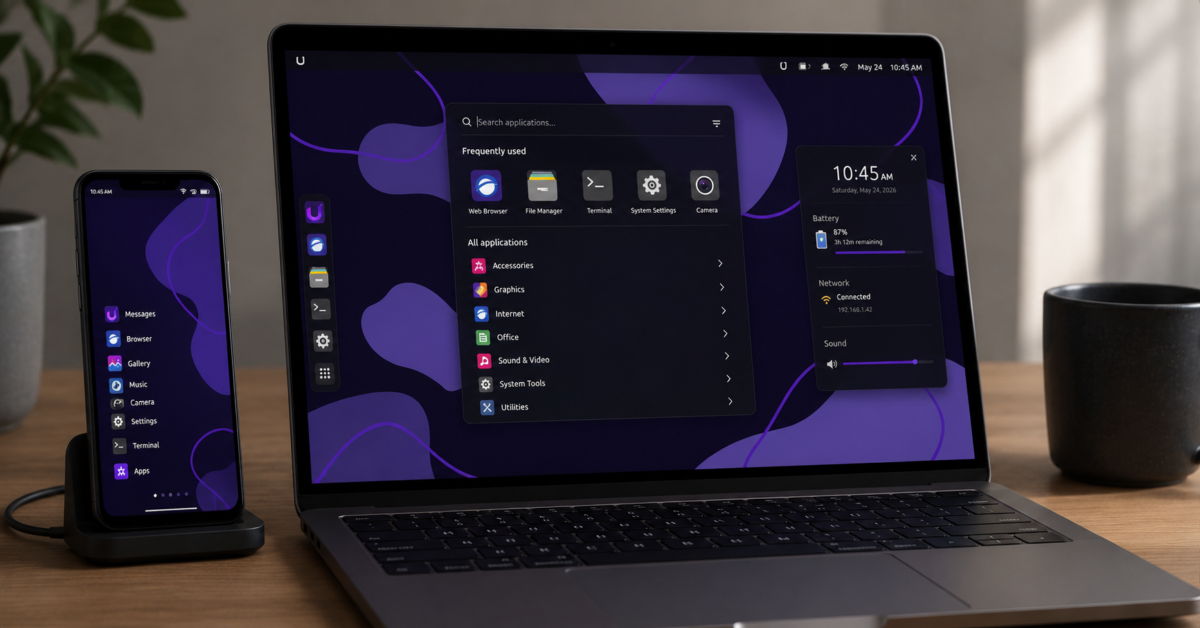
For years, Canonical pushed an ambitious idea called convergence. The concept was simple in theory but difficult in practice: one operating system that could power your phone, tablet, laptop, and desktop PC. Plug your phone into a monitor and suddenly it becomes a desktop computer. It sounded futuristic at the time, but Canonical eventually abandoned the effort, along with the Unity8 interface that powered it.
Now, that old vision is sort of getting another chance through Rhino Linux.
You see, the Ubuntu-based rolling release distribution has announced its new 2026.1 snapshot release, and the biggest news is support for Lomiri on generic x86_64 and ARM64 systems (download here). If you aren’t familiar, Lomiri is essentially the modern continuation of Unity8, kept alive by the UBports Foundation community after Canonical walked away from Ubuntu Touch nearly a decade ago.
For folks unfamiliar with Lomiri, it is not your typical Linux desktop environment. Unlike GNOME, KDE Plasma, or Cinnamon, Lomiri was originally designed with touchscreens and mobile devices in mind. It uses gestures heavily, adapts dynamically to different screen sizes, and was built around the idea that the same interface should work across phones and traditional PCs.
That does not mean Rhino Linux is suddenly trying to replace Android or compete with Windows laptops. In reality, Lomiri on desktop remains somewhat experimental. But there is something undeniably fascinating about seeing Canonical’s abandoned convergence dream still alive in 2026, especially as modern computing becomes increasingly centered around portable devices and hybrid workflows.
The release also includes several updates to Pacstall, Rhino Linux’s AUR-inspired package manager layer. The Pacstall 6.4.x series introduces new internal variables, expanded environment variable support, kernel version exporting to scripts, translation updates, and various bug fixes. Rhino Linux continues positioning Pacstall as a more flexible software installation experience for Ubuntu-based systems.
Kernel updates vary depending on hardware targets. Generic ISO images now ship with Linux kernel 7.0.9, while PinePhone, PineTab, PinePhone Pro, PineTab2, and Raspberry Pi images each receive their own hardware-specific kernels.
What makes this release interesting is not necessarily that Lomiri is suddenly ready to dethrone mainstream Linux desktops. It probably is not. Instead, Rhino Linux is offering something different: a chance to revisit an alternate future for Linux computing that many folks thought disappeared years ago.
Whether that future finally has another shot remains to be seen.
Support independent tech journalism
NERDS.xyz is independently owned and operated. If you enjoy my coverage of Linux, AI, hardware, cybersecurity, and tech culture, consider supporting the site on Ko-fi.
Support NERDS.xyz