
AI PCs are becoming the next big obsession for the tech industry, but all those fancy local AI features are going to need serious memory bandwidth to actually feel useful. That is the idea behind the latest announcement from Rambus, which just unveiled a complete DDR5 9600 Client Memory Module Chipset for future desktops and laptops built around AI workloads.
The company says the new chipset is designed for high-performance CUDIMM, CQDIMM, and CSODIMM memory modules that could appear in future gaming PCs, creator machines, and AI-focused laptops. Rambus believes emerging “agentic AI” workloads will put much heavier pressure on system memory as PCs begin handling more local inference, multitasking, automation, and real-time data processing.
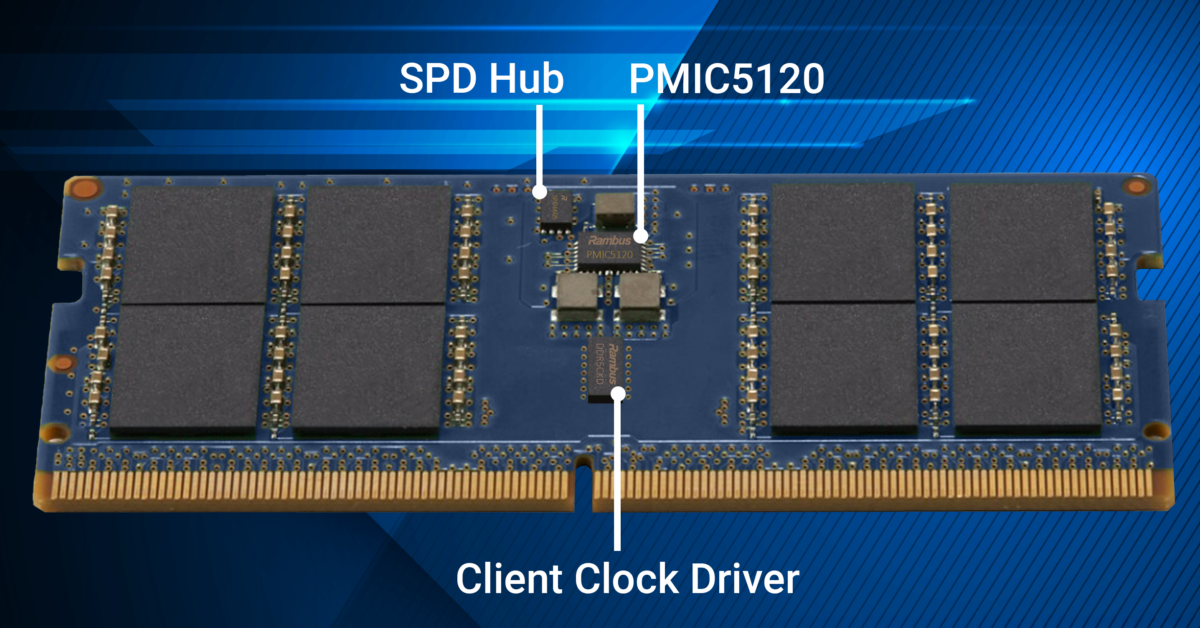
At the center of the launch is the company’s new Gen2 Client Clock Driver, called CKD02, which supports memory speeds up to 9600 MT/s. The chipset also includes the PMIC5120 power management IC and an SPD Hub for module communication and telemetry.
If you are wondering why memory makers suddenly care so much about clock drivers, it comes down to stability. As DDR5 memory speeds continue climbing higher, maintaining clean timing signals becomes increasingly difficult. That is why the industry is shifting toward clocked memory modules like CUDIMM and CSODIMM, which include onboard clock drivers to help keep everything stable at extreme speeds.
“Agentic workloads are fundamentally more memory-hungry, driving the need for higher memory bandwidth, greater capacity, and improved efficiency in AI-enabled PCs,” said Rami Sethi, senior vice president and general manager of Memory Interface Chips at Rambus. “Our DDR5 9600 Client Chipset, featuring the Gen2 Client Clock Driver, delivers the performance foundation needed to enable this new era of intelligent, high-performance client systems for AI-driven productivity, next-generation gaming and professional content creation.”
Jeff Janukowicz, research vice president at IDC, added, “To meet growing performance demands, the industry is transitioning to clocked memory architectures such as CUDIMM and CSODIMM, which are designed to address signal integrity and timing challenges at higher data rates.”
Whether regular folks actually need 9600 MT/s memory for AI remains another question entirely. Right now, much of the AI PC push still feels driven by hardware companies searching for the next upgrade cycle. Still, if AI features continue moving onto local devices instead of relying entirely on cloud processing, memory bandwidth could end up mattering a lot more than it does today.
Support independent tech journalism
NERDS.xyz is independently owned and operated. If you enjoy my coverage of Linux, AI, hardware, cybersecurity, and tech culture, consider supporting the site on Ko-fi.
Support NERDS.xyz