NVIDIA loves being cryptic, folks.
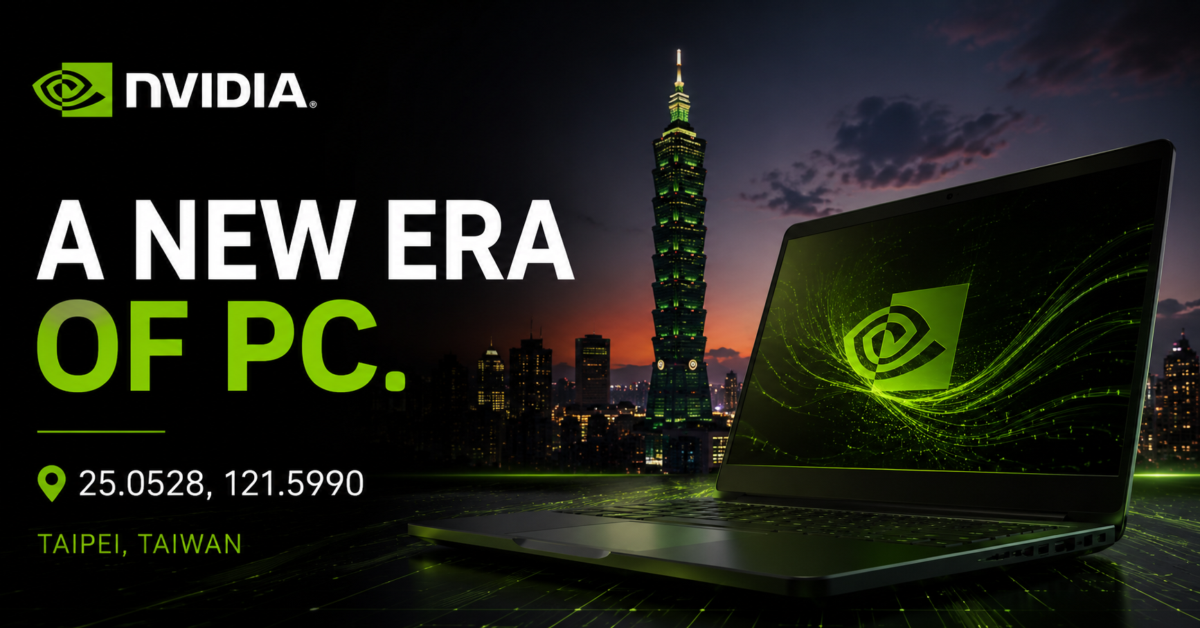
The AI giant posted a mysterious teaser to X that simply says “A new era of PC” alongside the coordinates 25.0528, 121.5990, which is a location that points directly to Taipei, Taiwan, home of Computex. Naturally, the speculation machine immediately kicked into overdrive.
To be fair, NVIDIA knew exactly what it was doing here.
The company could have announced whatever this is outright, but instead chose vague language that sounds far bigger than a normal GPU launch. Notice something important? NVIDIA did not say gaming PC. It did not say workstation. It did not even say AI PC. It just said “PC.”
That wording feels intentional.
For years, NVIDIA has mostly existed inside PCs as the graphics powerhouse. Sure, it dominates AI servers and gaming hardware, but the actual PC platform itself has traditionally belonged to Microsoft, Intel, AMD, and lately Qualcomm. That could be changing.
My first thought? NVIDIA may finally be preparing to push harder into ARM-based desktop or laptop systems designed around local AI workloads. We have already seen hints of this direction with projects like DGX Spark and partnerships focused on AI inference running directly on consumer hardware.
There is also the possibility this ties into Windows on ARM. Qualcomm has gotten a lot of attention recently with Snapdragon X Elite, but NVIDIA entering that space could shake things up fast. Imagine a future laptop powered by an NVIDIA-designed ARM chip paired with the company’s AI stack and GPU expertise. Whether consumers actually need that much AI in their PCs is another conversation entirely, but the hype would be impossible to ignore.
And that is really the question here: why would NVIDIA even bother with personal computing right now?
Look, the company is essentially printing money selling AI servers and data center hardware. Demand for its AI infrastructure is still absurd, cloud providers cannot buy enough GPUs, and NVIDIA has become one of the most powerful companies on Earth almost entirely because of enterprise AI workloads.
That is exactly why this teaser is so interesting.
If NVIDIA suddenly wants to talk about “a new era of PC,” it suggests the company sees something bigger brewing on the consumer side. Maybe Jensen Huang believes local AI computing eventually becomes just as important as cloud AI. Maybe NVIDIA thinks consumers will want private, offline AI systems running directly on laptops and desktops rather than constantly relying on remote servers.
Or maybe NVIDIA simply does not want Microsoft, Qualcomm, Apple, AMD, and Intel defining the future of personal computing without it.
Because right now, AI PCs still feel like a solution searching for a problem. Most folks are not waking up wishing their laptop had a built-in chatbot burning through battery life. NVIDIA entering the space could either legitimize the category overnight or expose just how overhyped parts of the AI PC movement really are.
Linux users should probably pay attention too.
If NVIDIA really wants to create a “new era of PC,” it cannot afford to ignore Linux developers, AI researchers, and enthusiasts. Those folks helped build the modern AI boom in the first place. The question is whether NVIDIA would embrace openness or double down on the locked-down ecosystem approach it has often favored in the past.
Another possibility is that this has less to do with laptops and more to do with compact AI desktops or mini PCs. AI-focused local systems are suddenly becoming trendy, especially as people grow uncomfortable sending every prompt and document to the cloud. NVIDIA could be betting that consumers and developers want powerful local AI machines sitting right on their desks.
Or maybe this ends up being something completely different.
That is the fun part about teasers like this. The internet gets to play detective for a few days before reality arrives. Sometimes the speculation ends up being more entertaining than the actual announcement.
Still, when NVIDIA says “a new era of PC,” people are going to listen. Whether this becomes a true shift in personal computing or just another AI buzzword parade remains to be seen.
Support independent tech journalism
NERDS.xyz is independently owned and operated. If you enjoy my coverage of Linux, AI, hardware, cybersecurity, and tech culture, consider supporting the site on Ko-fi.
Support NERDS.xyz