
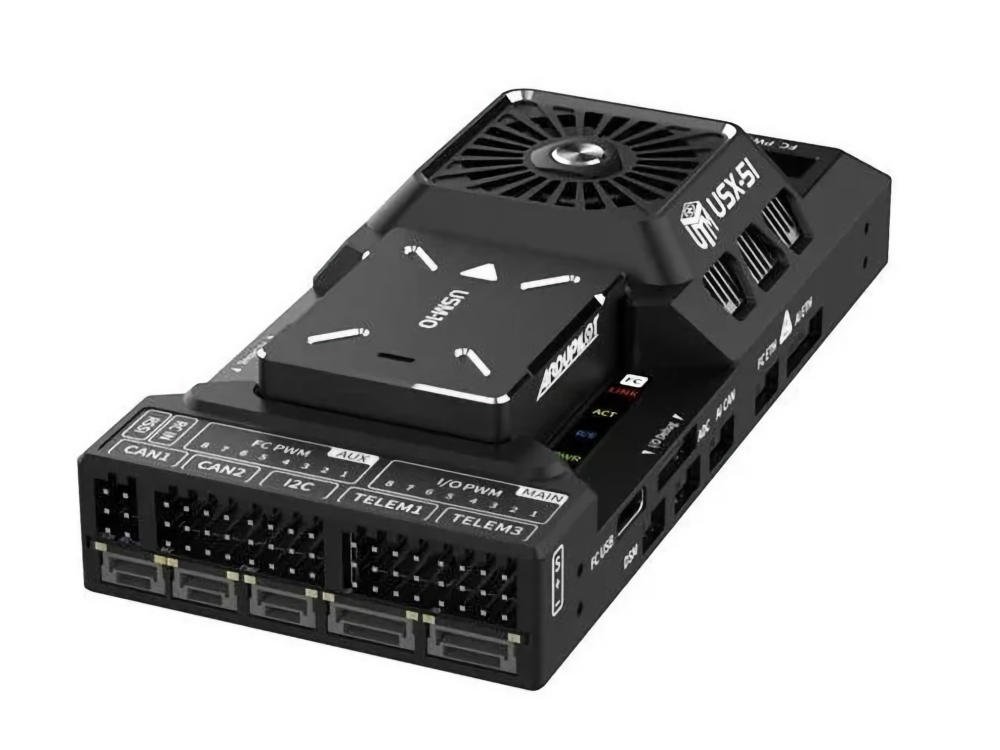
Industrial drones are getting smarter, and not just because of better cameras or longer flight times. Makerfire is now adopting the USX51 AI computing flight controller, a piece of hardware designed to bring real onboard processing power to enterprise drone deployments.
Instead of relying on remote servers or cloud connections to analyze data, this controller is meant to run AI workloads directly on the aircraft. That could matter for industries like infrastructure inspection, surveying, security monitoring, and mapping where drones often operate in places with spotty connectivity.
Under the hood, the hardware looks fairly serious for something designed to ride inside a drone. The flight management unit uses an STM32H753 Arm Cortex M7 processor running at 480MHz with 2MB of memory and 1MB of SRAM. A separate IO processor based on an STM32F103 Cortex M3 handles additional control functions.
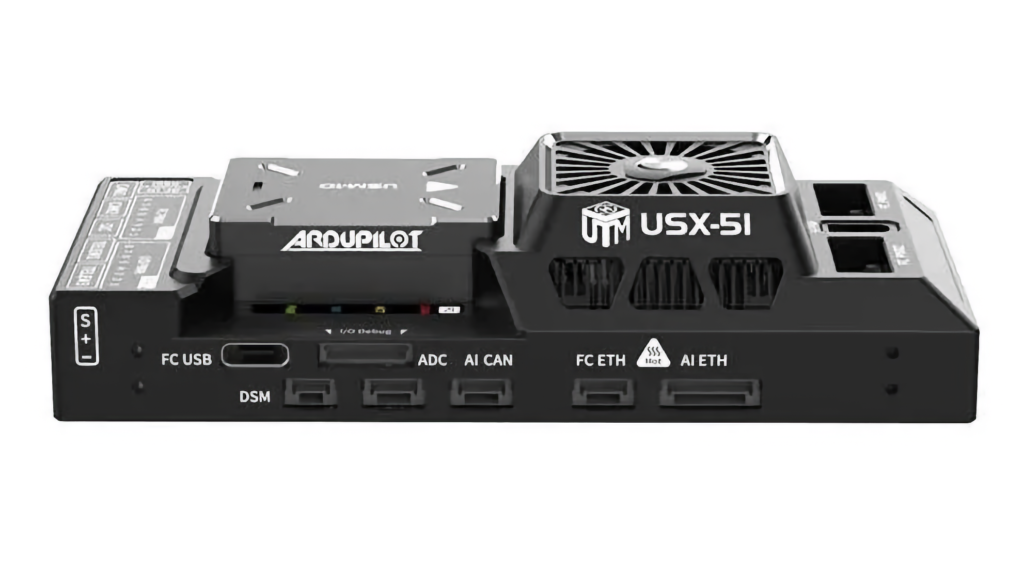
The onboard computer is where things get interesting. The platform includes eight Cortex A55 CPU cores running at 1.5GHz along with an AI accelerator capable of up to 10 TOPS of computing power. Makerfire says the system can support machine learning frameworks and perform tasks like visual recognition and object tracking directly on the aircraft.
Memory support goes up to 8GB of LPDDR4 or LPDDR4x, which is plenty for many edge AI workloads used in robotics and computer vision. The controller also includes multiple sensors for stability and environmental awareness, including three ICM 45686 accelerometer and gyro units, a BMM150 compass, and barometric sensors such as the BMP388 and ICP20100.
The physical hardware is compact enough for drone integration. The controller measures 122 × 58 × 28mm and weighs about 170 grams while consuming roughly 8.7 watts of power. It is rated to operate in temperatures ranging from minus 20 degrees Celsius to 60 degrees Celsius, which is important for drones flying in harsh outdoor environments.
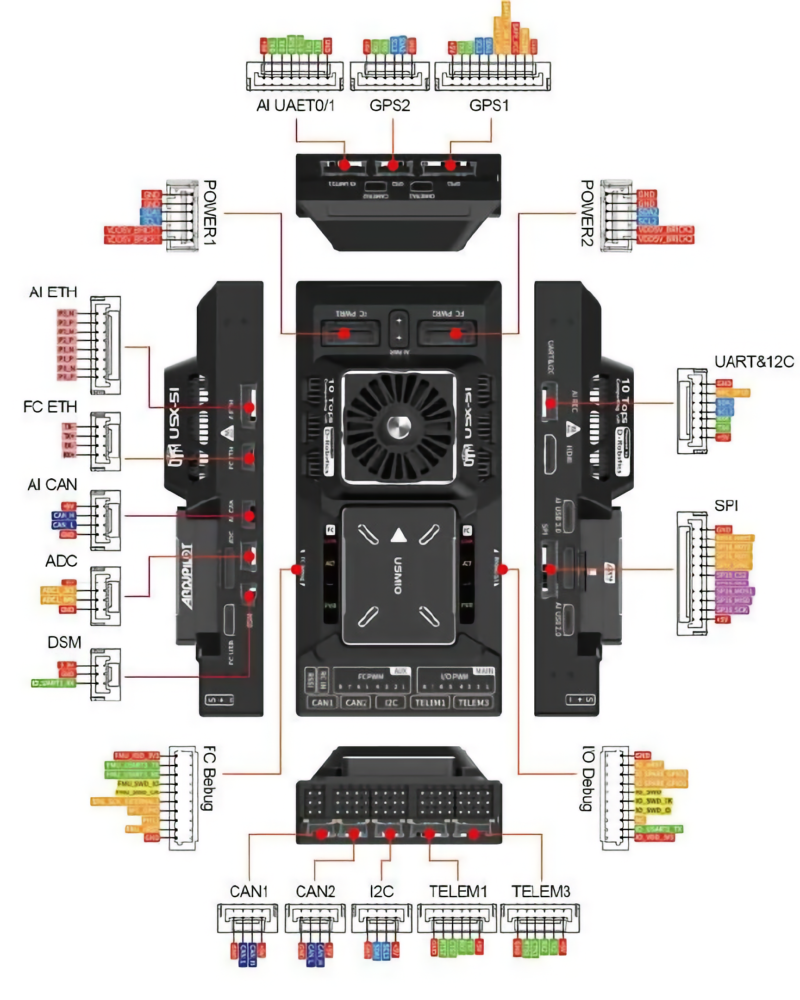
From a developer standpoint, the software stack may be the bigger draw. The platform supports Ubuntu 22.04 and ROS2 Humble, both widely used in robotics projects. That makes it easier for engineers to integrate AI models, automation workflows, and custom robotics software.
Makerfire also says the controller works with PX4 and ArduPilot firmware, two of the most widely used open drone flight stacks. If true, that compatibility could make the hardware appealing to companies already building drones around those ecosystems.
The bigger idea here is pretty straightforward. For years, many drones have been little more than flying sensors that stream data back to another system for processing. Edge AI hardware like the USX51 is meant to flip that model by putting the intelligence directly inside the aircraft.

Whether it actually delivers on those promises remains to be seen. Specs on paper can look impressive, but reliability and real world performance matter a lot more when drones are flying over infrastructure, construction sites, or industrial facilities.
Still, the direction of the industry seems clear. As processors get smaller and more efficient, the brains of autonomous machines are moving closer to the machines themselves. For drones, that could mean the flight controller gradually becoming the onboard computer that handles both flight and decision making.
If that happens, hardware like the USX51 may represent the kind of platform developers start building around.
Support independent tech journalism
NERDS.xyz is independently owned and operated. If you enjoy my coverage of Linux, AI, hardware, cybersecurity, and tech culture, consider supporting the site on Ko-fi.
Support NERDS.xyz