
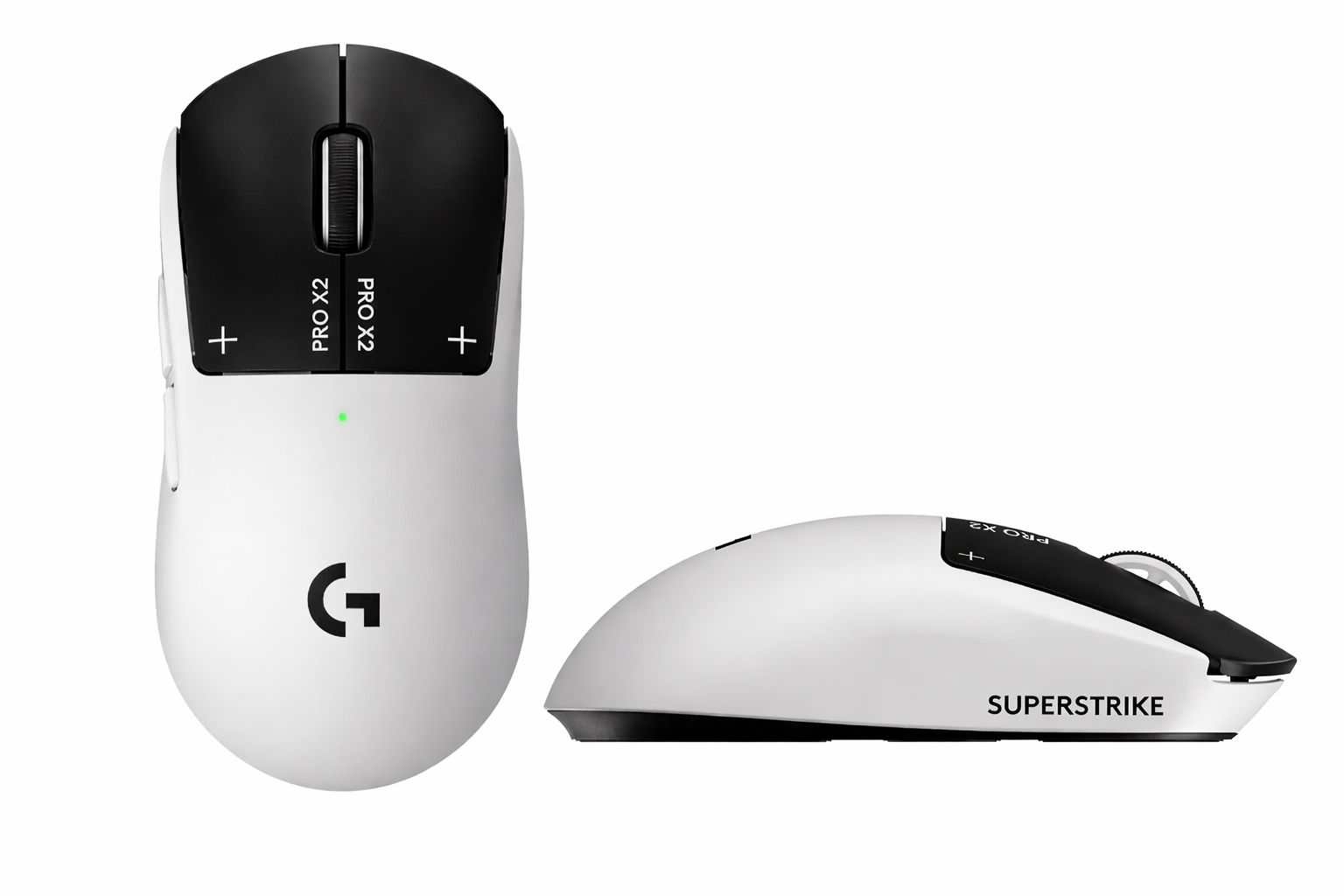
Gaming mice have hit a strange place. Sensors are already excellent, wireless latency is effectively solved, and weight reductions have reached diminishing returns. Logitech seems fully aware of that reality, because PRO X2 SUPERSTRIKE is not trying to reinvent the mouse as a whole. Instead, it zooms in on one very specific thing most hardware has treated as good enough for years, the click itself.
SUPERSTRIKE is built around Logitech’s Haptic Inductive Trigger System, or HITS, which replaces the traditional fixed-feel microswitch experience with something far more adjustable. The goal here is simple, at least conceptually. Reduce click latency as much as possible, shorten reset points, and let players tune how their clicks behave rather than forcing them into a one-size-fits-all switch design. Logitech claims this can translate into as much as a 30 millisecond advantage in click response under certain conditions, a number that will naturally raise eyebrows.
That figure deserves some skepticism. Human reaction time is already the dominant factor in most scenarios, and not every millisecond saved at the hardware level magically turns into a win. Still, competitive gaming lives on margins, and Logitech is clearly targeting players who want control over every variable, even ones most people never think about.
What stands out is how focused the design is. SUPERSTRIKE does not chase flashy aesthetics or pile on extra buttons. It sticks to a clean five-button layout with onboard memory, which means once you dial things in, you can move between systems without babysitting software. Logitech G HUB is still required to unlock the advanced tuning, including adjustable actuation depth, rapid-trigger behavior, and click-haptic intensity, but the mouse does not feel software dependent once configured.
Physically, this is very much a continuation of Logitech’s pro-grade mouse lineage. The shell dimensions are familiar, and the weight sits at 61 grams, light enough for fast movement without drifting into the hollow, fragile feel that some ultra-light mice suffer from. Players coming from the PRO X SUPERLIGHT family will feel at home immediately, which seems intentional. Logitech is not asking pros to relearn muscle memory. It is asking them to rethink how their clicks behave.
Tracking duties are handled by the HERO 2 sensor, with a DPI range stretching from 100 to an almost absurd 44,000. That upper limit is largely academic, but the lack of smoothing, acceleration, or filtering matters far more. Logitech continues to lean on raw, predictable tracking rather than software tricks, and that approach has earned trust over time. Maximum acceleration and speed ratings are extreme on paper, but realistically serve as reassurance that the sensor will never be the limiting factor.
Polling rate support pushes hard into enthusiast territory. Wired operation tops out at 1000 Hz, while LIGHTSPEED wireless can reach up to 8000 Hz, theoretically dropping report intervals to 0.125 milliseconds. As with click latency claims, whether most players can perceive the difference is debatable. What is not debatable is that Logitech is eliminating excuses. If latency exists, it is increasingly outside the mouse.
Battery life is rated at up to 90 hours of constant motion, which is respectable considering the performance focus. Real-world results will depend heavily on polling rate and usage patterns, but this does not look like a mouse that demands constant charging, which matters for consistency in competitive play.
Logitech has leaned heavily on professional validation with SUPERSTRIKE, and while marketing language tends to oversell those stories, there is value in knowing the hardware has survived real tournament use. Multiple players have highlighted not just speed, but comfort and reduced fatigue, especially during long gaming sessions. That is an under-rated angle. A mouse that feels better over hours of play can be more valuable than one that is theoretically faster in a lab test.
The interesting part of PRO X2 SUPERSTRIKE is not that it promises to make everyone better overnight. It will not. The real appeal is customization. By letting players adjust how far a button travels before actuating, how quickly it resets, and how the click feels under the finger, Logitech is treating the mouse like an instrument rather than a fixed tool. For some players, that control will be meaningless. For others, especially those who obsess over consistency, it could be the difference between comfort and constant micro-frustration.
SUPERSTRIKE does not redefine what a gaming mouse is. It narrows the focus instead. Logitech is betting that click behavior is the next frontier worth tuning, and that serious players care enough to engage with those settings. Whether the promised millisecond gains matter to you will depend on how you play and how sensitive you are to input feel.
The price reflects how niche this mouse really is. PRO X2 SUPERSTRIKE sells for $179.99, putting it firmly in premium territory even by esports hardware standards. That makes it a tough sell for casual players, but for competitors who obsess over input consistency and are willing to pay for marginal gains, this is clearly the audience Logitech had in mind.
Support independent tech journalism
NERDS.xyz is independently owned and operated. If you enjoy my coverage of Linux, AI, hardware, cybersecurity, and tech culture, consider supporting the site on Ko-fi.
Support NERDS.xyz