
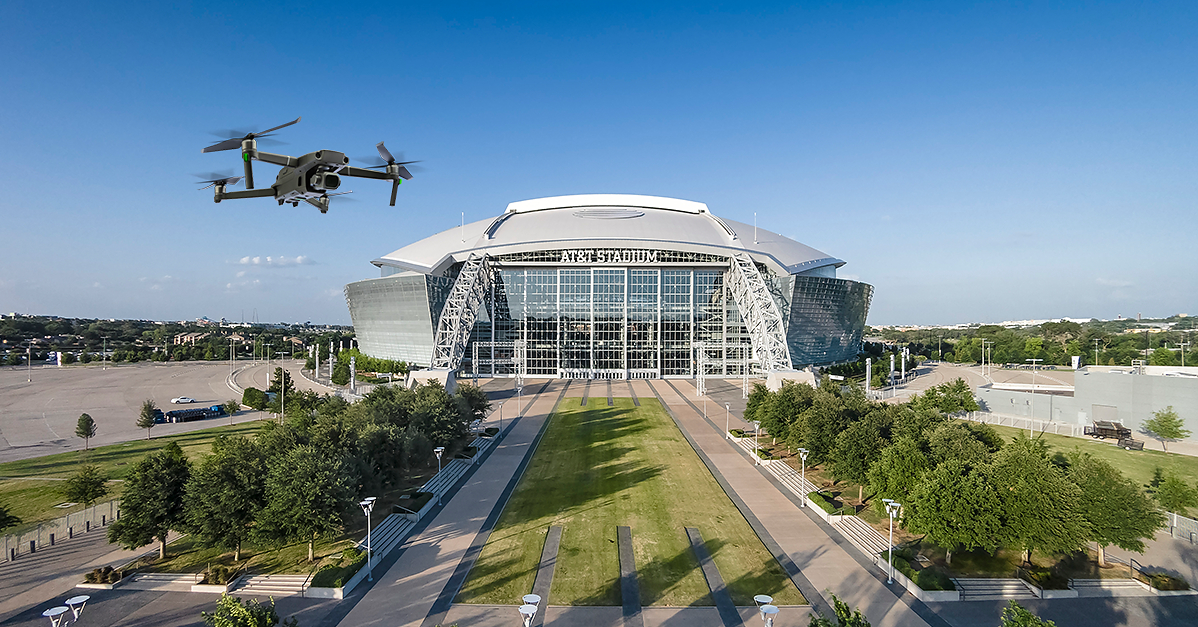
A drone flying near a stadium is not automatically dangerous, but security teams still need to know it is there.
AT&T and Ericsson have demonstrated how existing 5G infrastructure can detect, locate, and track drones in real time. The idea is to give authorities an early warning when an unauthorized aircraft enters sensitive airspace.
The test took place outside AT&T Stadium in Arlington, Texas. Using Ericsson Massive MIMO radios across several cellular sites, the companies tracked multiple drones flying between 300 and 400 feet.
The system measured each drone’s location, speed, altitude, and direction of travel.
That could be useful around stadiums, airports, military facilities, power plants, government buildings, and other crowded or sensitive locations. A drone might simply be filming, but it could also disrupt operations, interfere with emergency aircraft, or present a more serious security threat.
This technology does not appear to disable, capture, or knock drones out of the sky. It is an early-warning system that helps security teams see what is flying nearby and decide whether action is needed.
The interesting part is that AT&T and Ericsson used cellular infrastructure instead of relying entirely on a separate radar network. Ericsson says AI-based sensing software analyzed reflected wireless signals, while data from multiple synchronized sites improved tracking accuracy.
The companies are presenting this as an early look at integrated sensing and communication technology expected to play a larger role in 6G. That claim comes with a healthy amount of marketing, especially since commercial 6G networks are still years away.
Still, the basic idea is practical. If cellular towers can double as a drone detection network, venue operators and public agencies could gain broader visibility without installing dedicated sensors everywhere.
There is also a privacy concern hanging over the technology. A network capable of sensing movement across a wide area could be useful for security, but it could also become another form of infrastructure-based surveillance if those capabilities eventually expand beyond drones.
AT&T and Ericsson did not explain what safeguards, retention limits, or oversight would apply if the technology moves beyond controlled demonstrations.
That is an important omission.
For now, this is an experiment rather than a finished security product. Even so, as drones become more common, knowing what is flying overhead may become almost as important as keeping people connected below.
Support independent tech journalism
NERDS.xyz is independently owned and operated. If you enjoy my coverage of Linux, AI, hardware, cybersecurity, and tech culture, consider supporting the site on Ko-fi.
Support NERDS.xyz