
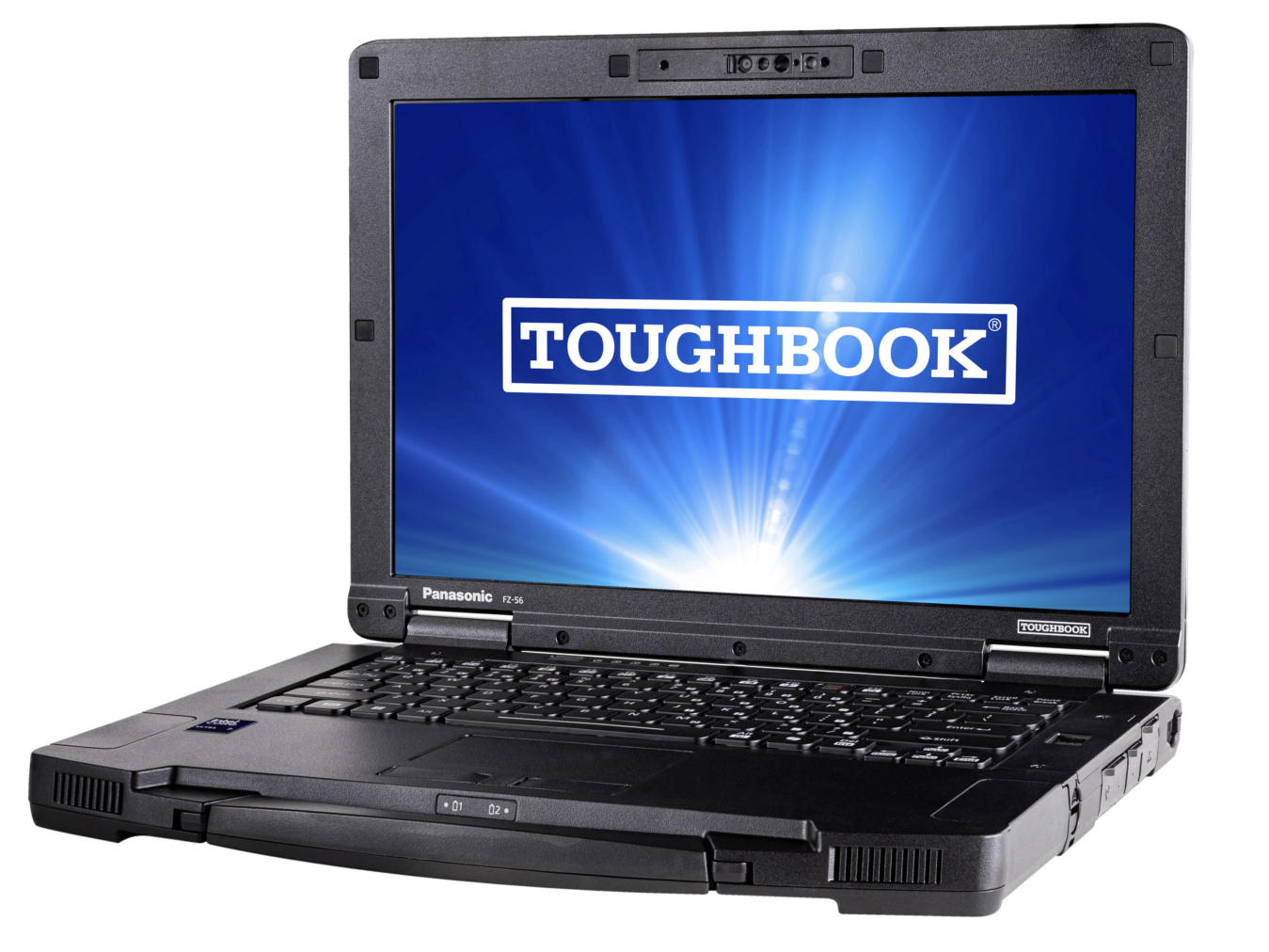
Most people never think about rugged laptops. That makes sense. If you work at a desk or on the couch, a regular notebook will do the job just fine. But there is an entire category of computers built for people whose jobs happen far away from a comfortable office. Police officers, utility crews, emergency responders, and field technicians all need machines that can survive rough conditions while still delivering real performance. That is exactly the market Panasonic Connect is targeting with the new TOUGHBOOK 56.
The company just introduced this latest rugged laptop as the successor to earlier models like the TOUGHBOOK 54 and TOUGHBOOK 55. If you have followed the Toughbook line over the years, you know Panasonic tends to move cautiously with updates. These systems are deployed in fleets, mounted in vehicles, and used in environments where downtime is not an option. That means compatibility and reliability often matter more than flashy redesigns.
Still, the TOUGHBOOK 56 does bring some meaningful upgrades. Panasonic Connect is positioning the machine as a rugged laptop ready for modern workloads, including some of the AI flavored tasks that companies keep talking about these days. The system runs on Intel Core Ultra Series 2 processors and can optionally include discrete graphics in the form of an AMD Radeon PRO W7500M with 8GB of VRAM. There is also an Intel Arc graphics option that Panasonic says can deliver noticeably better performance than prior generations.
The company claims those upgrades help the TOUGHBOOK 56 handle workloads like intelligent document processing, evidence analysis, machine diagnostics, and other data heavy tasks that field workers increasingly need to run locally. Whether every organization actually needs “AI at the edge” is another question, but at least the hardware here seems capable of backing up the marketing language.
Connectivity is another area where Panasonic clearly went all in. The TOUGHBOOK 56 supports Wi-Fi 7, improved 5G connectivity, and dual SIM support with both physical and eSIM options. Panasonic also highlights compatibility with major carrier networks and responder systems including AT&T, FirstNet, Verizon, Verizon Frontline, and T-Mobile. For emergency services and infrastructure workers who depend on reliable communication in chaotic environments, those details matter.
One unusual feature stands out too. Depending on configuration, the TOUGHBOOK 56 can support up to three Ethernet ports, including options for 2.5Gbps and even 10Gbps networking. That is not something you normally see on laptops, but in certain enterprise or field scenarios it could make transferring large datasets much faster.
Panasonic says customer feedback shaped several design tweaks as well. The laptop now uses a 16:10 display, which gives users more vertical space for documents, forms, and data tables. The speakers are roughly 50 percent louder than before, something that probably makes a lot of sense when you imagine trying to hear audio in a noisy truck cab or construction environment. There are also smaller quality of life improvements like a protective slide cover over the power port and new software controls for things like keyboard backlight timing.
Security is another major theme. Panasonic says the TOUGHBOOK 56 is the first rugged laptop to offer FIPS encrypted drives. It also supports the company’s broader TOUGHBOOK Total Defense security stack and a firmware protection feature called TOUGHBOOK Guard that is designed to detect hardware tampering before the device even reaches the customer. Supply chain security has become a bigger concern for governments and large organizations, so this sort of feature is not surprising.
For IT departments managing large deployments, the modular design may be the most appealing part of the system. The TOUGHBOOK 56 includes six modular areas that can house components like batteries, RAM, SSD storage, and expansion modules known as xPAKs. That flexibility can make repairs and upgrades much easier without replacing an entire device.
Another smart move is compatibility with existing docks. Panasonic says the TOUGHBOOK 56 will work with vehicle docks originally designed for the TOUGHBOOK 54 and TOUGHBOOK 55. Organizations that already have vehicles outfitted with mounting systems will probably appreciate not having to rip everything out just to adopt a new laptop model.
The rest of the specifications are what you would expect from a high end rugged machine. The TOUGHBOOK 56 features a 14-inch WUXGA display with optional 1000 nit touchscreen brightness, up to 64GB of DDR5 memory, and SSD options ranging from 512GB to 2TB with support for RAID-1 mirroring. Panasonic also says the system can deliver up to 24 hours of battery life with an optional second battery.
As for durability, Panasonic says the machine meets MIL-STD-810H testing standards, carries an IP53 rating for dust and water resistance, and can survive drops of up to three feet. That may not sound dramatic, but compared to most consumer laptops, it is a very different level of toughness.
Of course, this kind of hardware comes at a price. Panasonic Connect says the TOUGHBOOK 56 will start at $3,325 when it becomes available in May. That might sound steep if you are used to shopping for everyday laptops, but rugged systems have always lived in a different pricing universe. For organizations that depend on these machines in the field, durability and serviceability usually matter more than saving a few hundred dollars.
Support independent tech journalism
NERDS.xyz is independently owned and operated. If you enjoy my coverage of Linux, AI, hardware, cybersecurity, and tech culture, consider supporting the site on Ko-fi.
Support NERDS.xyz