
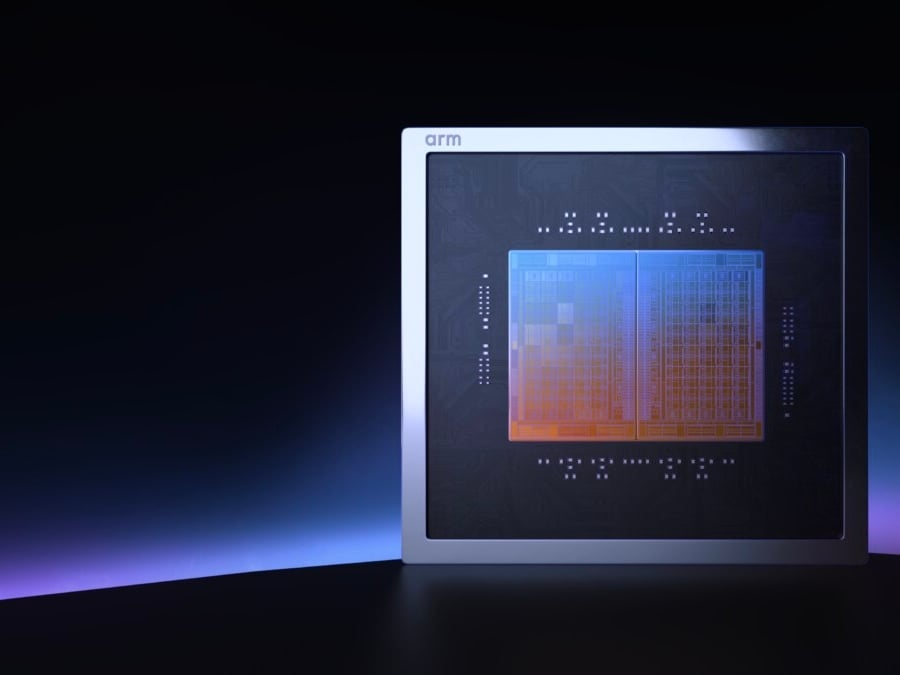
Arm has spent decades powering other companies’ processors. Quietly, efficiently, and very profitably. But that long-standing model just took a turn. For the first time, Arm is no longer sticking to blueprints. It is now making actual chips, and it is going straight after AI infrastructure.
The new Arm AGI CPU is its opening shot.
This isn’t a mobile chip or some edge experiment. It is a full-on data center processor designed for what Arm keeps calling “agentic AI.” In plain English, that means AI systems that don’t just respond, but constantly think, plan, and act. Those workloads don’t just hammer GPUs. They lean heavily on CPUs too, especially for coordination, scheduling, and moving data around.
Arm is betting that this shift creates a huge opportunity. The company claims data centers could need more than four times the CPU capacity per gigawatt as AI agents scale up. That is a big claim, but if even partially true, it explains why Arm suddenly wants a bigger piece of the pie.
The specs are quite aggressive. Up to 136 Neoverse V3 cores per CPU. High memory bandwidth per core. A design focused on consistent performance under load instead of short bursts. Arm is also leaning hard into density, talking about thousands of cores per rack with air cooling, and far more with liquid setups.
And yes, there is a jab at x86. Arm says this chip can deliver more than twice the performance per rack compared to traditional server CPUs. Maybe. We have all seen these vendor comparisons before, so it is worth waiting for independent testing before declaring anything dead.
Still, the bigger story here is not the benchmark claims. It is the strategy shift.
Arm is stepping into territory that overlaps with its own partners. That is not a small move. Companies like Amazon, Google, and Microsoft already build their own Arm-based chips. Now Arm is offering its own finished silicon alongside the IP and subsystems it already sells.
That could get awkward…
To soften that, Arm is pitching flexibility. Partners can still license designs, use compute subsystems, or adopt Arm’s own chips. In theory, everyone wins. In reality, it depends on whether customers see this as helpful or as Arm inching into their lane.
Meta, for its part, is all in early. It helped co-develop the AGI CPU and plans to use it alongside its own AI silicon. That is a strong endorsement, even if it is just one company. Arm also name-dropped a long list of ecosystem players, including OpenAI, Google, Microsoft, NVIDIA, and others. That signals interest, but not necessarily commitment to this specific chip.
Let’s be honest about timing too. Arm is not leading this trend. Hyperscalers have been building custom Arm silicon for years now. In a lot of ways, Arm is catching up to what its own ecosystem already proved was possible.
But the AI boom changes the math. When demand for compute explodes, there is room for more players. Arm clearly believes the market is big enough that its move into actual chipmaking will not scare partners away.
That is the gamble.
If the AGI CPU gains traction, Arm could move from being the foundation of other people’s chips to a direct force in the data center. If it doesn’t, it risks complicating the relationships that made it successful in the first place.
Either way, this is not a small tweak to its business. It is a line in the sand. Arm is done just licensing the future. Now it wants to build it too.
Support independent tech journalism
NERDS.xyz is independently owned and operated. If you enjoy my coverage of Linux, AI, hardware, cybersecurity, and tech culture, consider supporting the site on Ko-fi.
Support NERDS.xyz