People already ask AI chatbots all sorts of health questions, and I understand the appeal. Medical terminology can be confusing, lab results can be intimidating, and getting a doctor on the phone is not always easy. Having something explain it all in plain English sounds pretty useful.
Of course, sounding helpful and being correct are two different things. When the subject is your health, a convincing answer that gets something wrong could create a much bigger problem than a chatbot recommending a lousy restaurant.
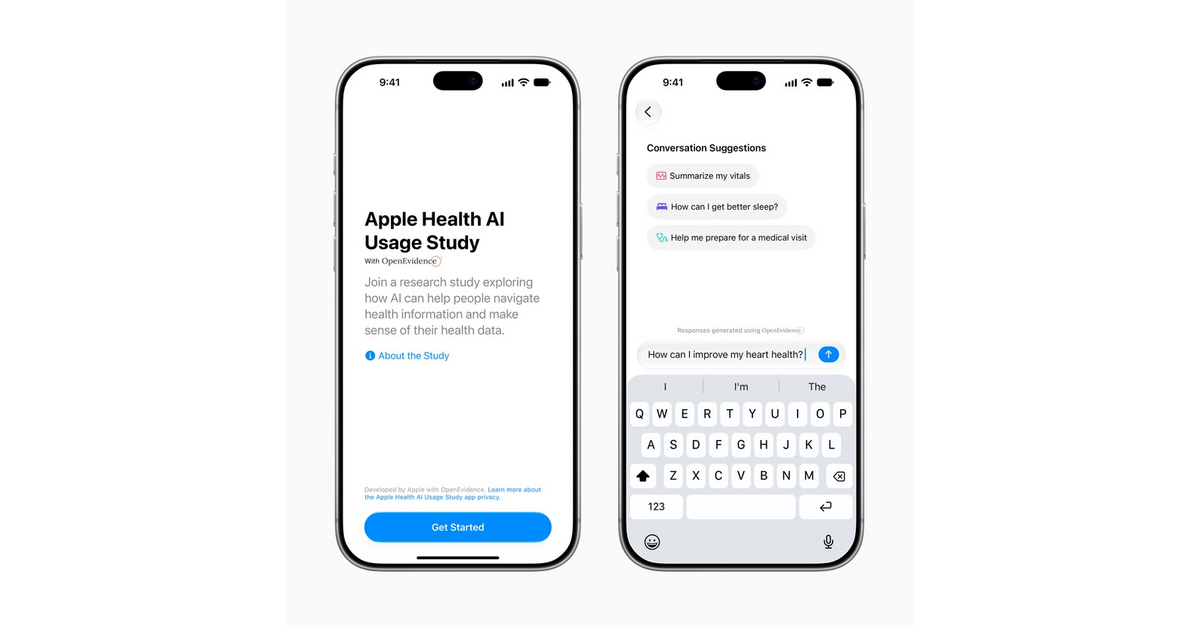
Apple is now launching a research study to better understand how people interact with health AI. Announced today, the Apple Health AI Usage Study will accept up to 200,000 eligible participants in the United States, with OpenEvidence providing the medical AI technology behind the experience.
Participants will use a dedicated study app to ask everyday health questions and explore medical information. Apple says the research will examine trust, comprehension, response quality, and everyday health actions. In other words, it wants to understand what people take away from these conversations and how they respond to them.
That is worth studying, because an AI answer can be easy to read without being easy to properly evaluate. If it sounds confident and includes medical citations, people may give it more authority than they otherwise would. The question is whether that trust is earned.
OpenEvidence generates answers using medical information from sources including The New England Journal of Medicine, Journal of the American Medical Association, and Nature. The study app will show linked, peer-reviewed clinical citations supporting its responses, giving participants a way to examine the underlying material.
I like that part, although attaching a citation does not automatically make an answer correct. The system still needs to interpret the information properly, and the person reading it needs to understand what does and does not apply to their situation. A link to a medical journal is useful, but it is not a magic accuracy button.
“At Apple, we believe responsible innovation starts with scientific rigor and clinical grounding. Health is deeply personal, and conducting a dedicated research study is the most thoughtful way to understand how people engage with, comprehend, and evaluate health AI in everyday life,” said Sumbul Desai, M.D., Apple’s vice president of Health and Fitness.
Participants can optionally share HealthKit information, such as resting heart rate, activity, sleep, and lab results. The study will examine whether incorporating that personal data makes the responses more relevant and improves understanding.
This is where I would become a little more cautious. Asking what a particular blood test measures is one thing. Letting an AI system incorporate your own results makes the experience feel much more personal, and potentially much more convincing. That does not necessarily mean its conclusions deserve more trust.
Apple says study data will not be used to train AI models, which is an important detail. Participants also control whether they share HealthKit metrics or survey responses, and Apple says it has security measures in place to protect the study information it maintains.
Still, I would read the consent and privacy information before handing over health data. Knowing that information will not be used for model training is helpful, but I would also want to understand how it is used and handled throughout the research.
The app includes guardrails intended to detect certain concerning questions and direct participants toward a healthcare provider or other resources when needed. Apple also acknowledges that health tools powered by large language models can produce incomplete or unclear responses. That acknowledgment needs to remain part of the conversation as companies promote these experiences.
One goal I particularly like is exploring whether AI can help people prepare for appointments with their own doctors. Explaining unfamiliar terms and helping someone organize questions could be useful, especially when appointment time is limited. Whether the app actually does that well is something the research will need to establish.
To participate, you must be an eligible U.S. adult age 21 or older with an Apple Intelligence-enabled iPhone running iOS 26 or later. Apple says the app is not intended to diagnose or treat conditions, and it does not replace advice from medical professionals.
I like the idea behind this study, but I would not confuse its launch with proof that health AI is ready to be trusted. Hopefully, Apple learns more than whether people enjoy using the app. We need to know whether they understand its limitations, particularly when an answer sounds exactly like what they wanted to hear.
Support independent tech journalism
NERDS.xyz is independently owned and operated. If you enjoy my coverage of Linux, AI, hardware, cybersecurity, and tech culture, consider supporting the site on Ko-fi.
Support NERDS.xyz