
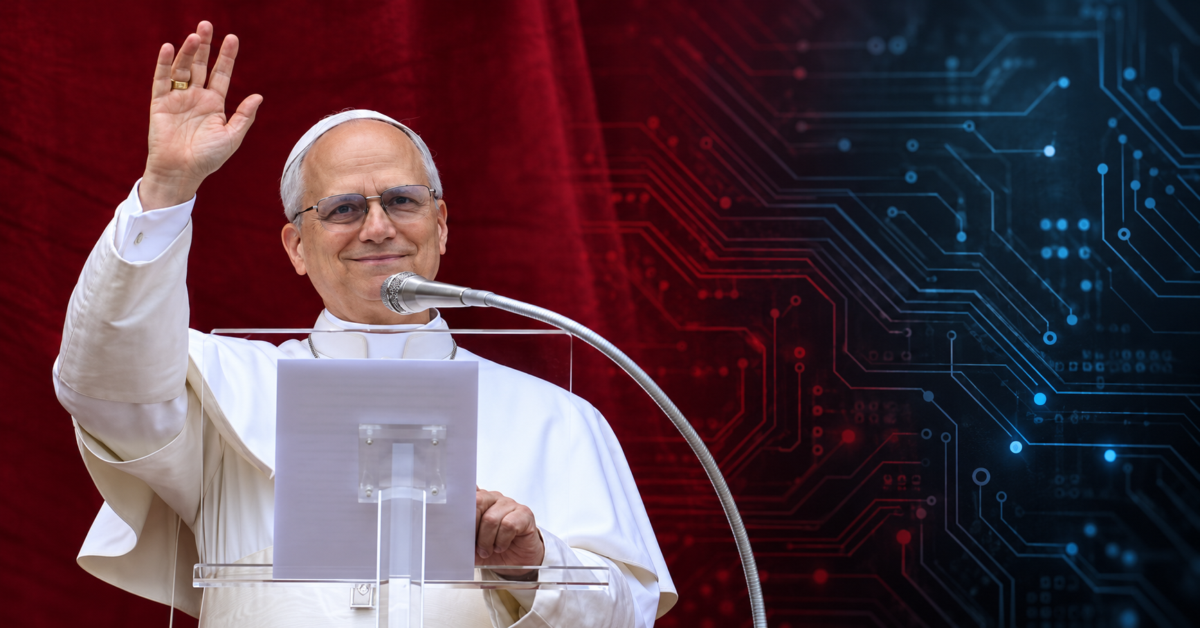
As a Catholic and a technology journalist, I pay attention when Pope Leo XIV talks about artificial intelligence. His latest comments deserve attention well beyond the Church, particularly from anyone concerned about who will be held responsible when an AI system causes harm.
In a thread on X, the pope calls for human oversight, independent accountability, and steps toward banning lethal autonomous weapons. He also challenges the idea of granting AI systems rights or legal personhood, warning that doing so could leave victims facing something that cannot meaningfully answer for its actions.
“Machines are tools, not persons,” Pope Leo XIV writes. “Today, some propose granting these systems rights, or even legal personhood. Such an approach risks obscuring human responsibility and leaving those who suffer harm to confront a faceless entity.”
That last part is what sticks with me. If a business deploys an AI system that hurts someone, the person affected deserves answers from the people who built, approved, or operated it. “The AI did it” should never become an acceptable excuse for avoiding scrutiny.
You do not need to share my faith to recognize the problem here. A system can produce convincing language and carry out complicated tasks without being an appropriate substitute for human responsibility. Giving it a name and a friendly personality does not answer the question of who must fix things when something goes wrong.
The pope makes his most urgent demand when addressing decisions involving human life, freedom, and force. He says those decisions must remain subject to effective, informed, and responsible human oversight, and he urges states meeting in Geneva in November to take concrete steps toward banning lethal autonomous weapons.
“For this reason, artificial intelligence must be ‘disarmed’,” he writes, before making that appeal. The focus here is on preventing machines from being handed authority over decisions with potentially fatal consequences.
There is a world of difference between an AI tool getting a shopping recommendation wrong and a system making a decision that costs someone their life. The latter demands a level of accountability that cannot be satisfied by a reassuring presentation or a vague promise that someone is supervising.
The word “informed” in his call for oversight matters, too. My view is that human involvement means little if the person supervising cannot understand the system well enough to question its output or meaningfully intervene. Having someone available to approve a recommendation is hardly comforting if approval becomes little more than a formality.
Pope Leo XIV also pushes back against the assumption that the future of AI has already been decided. Because humans develop the technology, he argues, humans remain responsible for choosing its direction, including changing or rejecting particular applications.
“A reliable system that serves the human person is of greater value than one that is exceptionally powerful but whose consequences cannot be adequately foreseen or controlled,” he writes. That is a useful standard for judging technology, especially when capability can be easier to demonstrate than reliability.
I like that this leaves room for useful AI. His argument allows us to ask whether a particular application deserves to exist, whether it is sufficiently controllable, and whether its benefits justify the consequences. Those are reasonable questions to ask before people are expected to live with the results.
There is also an economic dimension to the thread. The pope says intelligent technologies should serve the common good and that the benefits of progress should be shared equitably, “especially with those most in need.”
As a Catholic, that emphasis resonates with me. As someone who covers technology, I think it raises a practical test: does an application improve life for the people expected to use it, or are those people simply being asked to accommodate decisions made for someone else’s benefit?
His final point concerns enforcement. Pope Leo XIV calls for international institutions, shared standards, independent oversight, and ways to challenge AI decisions and obtain appropriate remedies for harm.
That is where this discussion needs to go. Ethical principles are useful, but people harmed by a system need a process that can deliver answers and a remedy. The humans making decisions about AI should be prepared to explain those decisions and accept responsibility for their consequences.
Support independent tech journalism
NERDS.xyz is independently owned and operated. If you enjoy my coverage of Linux, AI, hardware, cybersecurity, and tech culture, consider supporting the site on Ko-fi.
Support NERDS.xyz