
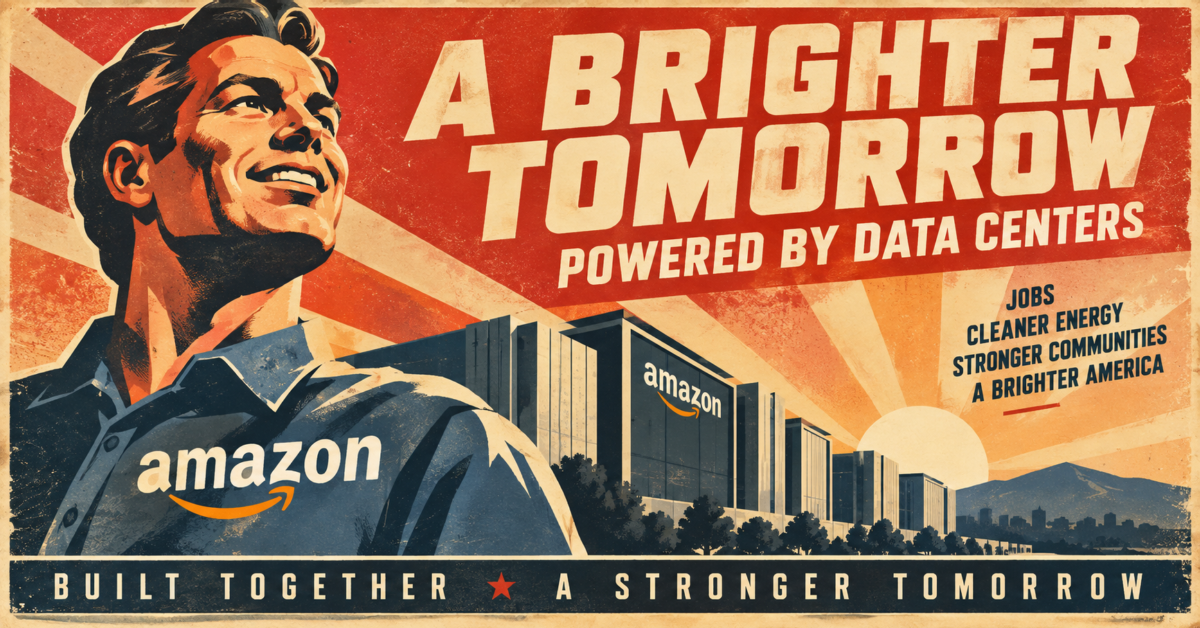
Amazon has a message for Americans worried about the explosion of data centers across the country: You have been misled. The company would like you to believe many of the concerns surrounding these massive facilities simply aren’t true.
In a lengthy post written by Amazon Web Services CEO Matt Garman, the company attacks what it calls “misinformation and outright lies” surrounding data centers. Amazon then presents its own collection of facts and figures explaining why concerns about water consumption, electricity prices, pollution, and community impact are supposedly overblown.
Now Amazon is putting more than $1 billion behind that message. The company has announced Built Together, a five-year community investment program targeting areas where Amazon operates data centers.
The money will support education, job training, energy affordability, water and energy conservation, and other local projects. Those investments may very well do some good, but make no mistake: Amazon’s announcement is also propaganda.
Amazon has an enormous financial interest in convincing Americans that massive data centers are good for their communities. With artificial intelligence driving demand for computing infrastructure, opposition to new facilities could interfere with the company’s ability to expand AWS.
Amazon isn’t particularly subtle about the stakes, either. Garman compares today’s data center expansion to the construction of America’s interstate highway system and argues that falling behind in AI could hurt the United States for generations. He even points to reports of foreign countries allegedly spreading misinformation about data centers in an effort to slow American development.
That’s an awfully dramatic backdrop for a corporate announcement about community investment. Amazon then moves into a “Myths vs Facts” section that reads like a ready-made defense of the data center industry.
On water consumption, for example, Amazon says the average data center uses about 170,000 gallons per day, while its own facilities average less than 13,000 gallons. It also says U.S. golf courses consume roughly 200 times as much water as all Amazon data centers combined.
When it comes to electricity prices, Amazon calls blaming data centers “misleading and convenient scapegoating.” The company argues that aging electrical grids are primarily responsible for rising rates in affected areas and says the money it pays utilities covers infrastructure improvements required by its facilities.
Amazon makes similar arguments about pollution and economic benefits. It says backup generators at data centers sit idle 99.9 percent of the time and points to construction jobs, permanent positions, and tax revenue generated by its projects.
Some of those numbers may provide useful context, but Amazon isn’t a neutral observer studying whether data centers benefit communities. It is one of the companies building them, and its business depends heavily on having the infrastructure needed to keep expanding.
That’s what makes Built Together so interesting. Amazon says it will spend more than $1 billion over five years on top of its existing community investments, including programs involving education and workforce development.
The company expects to connect more than 300,000 students with free access to community college degrees in data center communities. It also plans to expand its Modular Training Centers, which provide training for electricians, fiber technicians, and other workers.
There is money for homeowners and public buildings, too. Amazon says programs involving upgrades such as heat pumps, HVAC systems, insulation, batteries, and solar installations could reduce energy bills by 20 to 40 percent, with more than 30,000 homes and 300 schools and community buildings targeted over five years.
Again, those are potentially worthwhile investments. Calling Amazon’s broader message propaganda doesn’t mean every program it announces is bad or every statistic it provides is false.
It means Amazon is trying to persuade you, and the company has plenty of reasons to do so. Amazon needs enormous amounts of infrastructure to support AWS and the AI boom, while communities are asking harder questions about electricity, water, land, noise, pollution, and what they actually receive in exchange for hosting these facilities.
Amazon says more than 100 data center moratoriums are currently being considered around the country. Against that backdrop, spending $1 billion on communities isn’t simply generosity; it also gives Amazon a powerful argument whenever someone asks whether another giant data center should be built nearby.
Amazon wants Americans to view data centers as essential national infrastructure rather than industrial projects that deserve intense local scrutiny. It also wants concerns about their impact viewed through the lens of “myths,” misinformation, and even foreign interference.
Perhaps Amazon really can build more data centers while protecting water supplies, preventing residential electricity increases, creating good jobs, and leaving communities better off. Those claims deserve independent scrutiny, however, not just a 12-minute sales pitch from the CEO of AWS.
Amazon is putting more than $1 billion behind that pitch. And $1 billion buys one hell of a sales pitch.
Support independent tech journalism
NERDS.xyz is independently owned and operated. If you enjoy my coverage of Linux, AI, hardware, cybersecurity, and tech culture, consider supporting the site on Ko-fi.
Support NERDS.xyz