
Microsoft keeps making Windows a better place to develop with Linux. Now, the company is taking another big step by baking Linux container support directly into WSL.
Microsoft says WSL Containers is now generally available, giving developers a built-in way to build, run, and deploy Linux containers on Windows. The feature comes with the latest WSL release and could reduce the need for a separate container platform in some development setups.
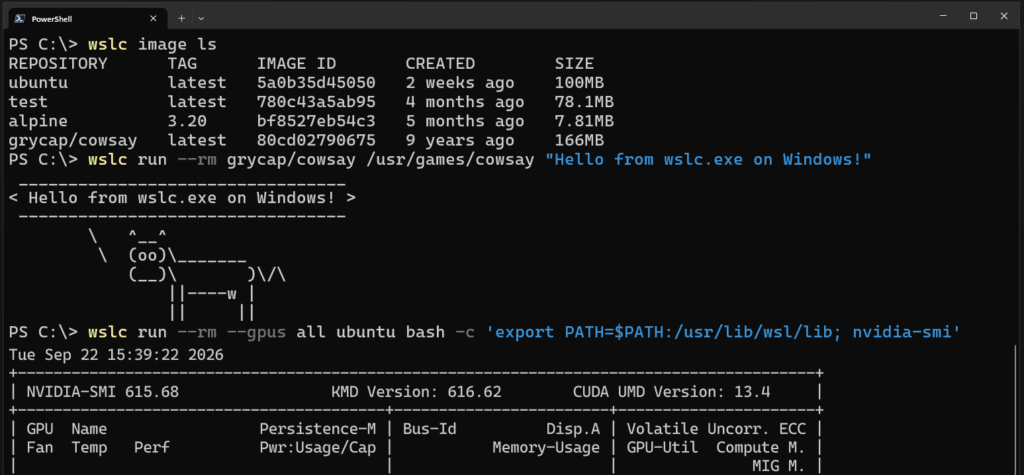
Developers get access to wslc.exe, a command-line interface for working with containers. Microsoft also provides container.exe as an alias, while a new API allows native Windows applications to launch and manage Linux containers programmatically.
That last part could become particularly useful for local AI. A Windows application could potentially spin up an isolated Linux environment for an AI model or agent without asking the user to manually configure a separate container platform.
The general availability release fills in many of the gaps from Microsoft’s public preview. WSL Containers can restart containers, copy files in and out, inspect environments, manage networks, stream events, perform health checks, configure stop timeouts, and mount storage.
Microsoft is also thinking about businesses that need more control over what developers are doing. Defender for Endpoint can expose process, file, and network activity from containers, while Intune administrators can enable WSL Containers and restrict the registries that developers are allowed to use.
Performance gets some attention too. Microsoft claims WSL Containers can offer up to twice the performance when Linux environments access files stored on Windows. A new networking mode called consomme is intended to improve compatibility across different Windows networking configurations.
The obvious comparison is Docker Desktop. WSL Containers doesn’t suddenly make Docker Desktop, Podman Desktop, or Rancher Desktop unnecessary, especially for developers who depend on their broader tooling and established workflows. It does, however, give Windows users another option without requiring an additional container platform.
There is also one pretty big piece missing: Compose. Microsoft says Compose is the most requested WSL Containers feature and is now a priority. The eventual goal is to let developers run wsl compose up against existing compose.yaml files without having to modify them.
Until that arrives, WSL Containers will probably feel incomplete for plenty of developers. Still, getting Linux container support directly from Microsoft makes WSL considerably more capable than it was before.
Windows and Linux stopped being strange bedfellows a long time ago. At this point, Microsoft seems increasingly comfortable treating Linux as just another part of the Windows development experience, and WSL Containers pushes that relationship a little further.
Support independent tech journalism
NERDS.xyz is independently owned and operated. If you enjoy my coverage of Linux, AI, hardware, cybersecurity, and tech culture, consider supporting the site on Ko-fi.
Support NERDS.xyz