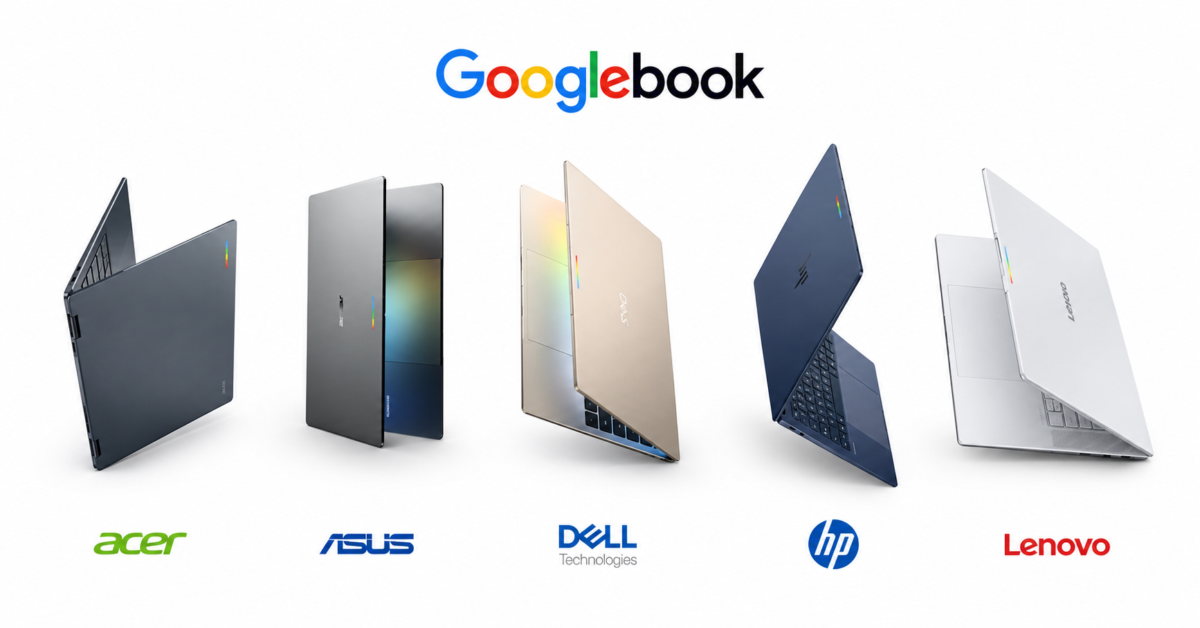
Google has officially unveiled Googlebook, and on paper, there is plenty to like. The new premium laptops start at $899, come from Acer, ASUS, Dell, HP, and Lenovo, and offer some legitimately interesting hardware. Unfortunately, Google also seems determined to make sure you get the most from one only if you are already living inside its ecosystem.
In fact, Google isn’t exactly hiding this. The company literally calls Googlebook “the laptop your Android phone has been waiting for.” That sounds wonderful if an Android phone is sitting in your pocket. If you use an iPhone, however, Googlebook immediately becomes a much harder sell.
Googlebook is built using the Android technology stack combined with desktop foundations from ChromeOS. More importantly, some of its most interesting features revolve around an Android phone. Google says your Android settings, saved passwords, Wi-Fi networks, and messages can move over when setting up the computer.
Then there is Continue On, which lets you begin something on an Android phone and resume it on Googlebook. The Files app can access files and photos stored on your phone, while Cast My Apps can stream Android apps into windows on the laptop. These are genuinely useful ideas, but Google specifically describes them as benefits for Android users.
That leaves me wondering why an iPhone owner would spend at least $899 on one.
Yes, you would still get a computer. Googlebook includes desktop Chrome with extensions, access to Android apps, and an isolated Linux environment with a full terminal. Developers can run tools such as Claude Code, and Google even includes its Antigravity development platform. There is quite a bit here beyond Android phone integration.
The hardware sounds good too. Google says every model starts with 16GB of RAM, while some configurations reach 32GB. Buyers can choose Intel Core Ultra Series 3 or Snapdragon X Elite processors, and Google claims as much as 16 hours of web browsing. Displays can reach 2.8K resolution, while premium materials include aluminum, magnesium alloy, and carbon fiber.
Google is even bringing back the Glowbar, which can display charging information and perform animations. Developers will be able to access it too, potentially making the little strip more useful than a glorified battery light.
But hardware isn’t really the Googlebook story. The ecosystem is.
Gemini sits all over this thing. Magic Pointer lets you wiggle the cursor and bring Gemini into whatever you are doing. It can analyze something on the screen, work with images, or even take information from a webpage and put events into Google Calendar.
Rambler turns rambling voice input into organized text, while Create My Widget generates custom desktop widgets from natural-language descriptions. Google says Gemini can also perform tasks in the background after you close the laptop.
Individually, some of this sounds really cool. Collectively, though, Googlebook starts looking less like a general-purpose computer and more like a very expensive front door into Google.
Buy the laptop. Connect your Android phone. Use Chrome. Run Android apps. Talk to Gemini. Put things in Google Calendar. Store things in Google’s cloud. Google is even throwing in 12 months of Google AI Pro and 5TB of cloud storage with every Googlebook.
Of course, ecosystem lock-in isn’t something Google invented. Apple has spent years making the Mac more attractive when paired with an iPhone, and Microsoft increasingly ties Windows into its own services. The difference is that Googlebook arrives as an entirely new laptop category, giving buyers a chance to ask an important question before jumping in: Do I really want my computer to pull me deeper into Google’s ecosystem?
For Android users who already rely heavily on Google services, the answer could easily be yes. Googlebook appears designed specifically for them, and the phone integration could make it an appealing alternative to Windows.
For iPhone users, I am far less convinced. Many of Googlebook’s headline integration features lose their appeal when the phone in your pocket isn’t running Android. At $899 and up, that matters when a MacBook naturally fits into Apple’s ecosystem and Windows gives buyers an enormous selection of hardware without making Android the centerpiece of the experience.
Googlebook looks interesting. I actually want to play with one. The Linux environment alone catches my attention, and some of the Gemini features sound genuinely useful.
But Google may have built a premium laptop that works best for people who have already pledged allegiance to Google. Everyone else should probably think carefully before handing over $899 for the privilege of being encouraged to do so.
Support independent tech journalism
NERDS.xyz is independently owned and operated. If you enjoy my coverage of Linux, AI, hardware, cybersecurity, and tech culture, consider supporting the site on Ko-fi.
Support NERDS.xyz