
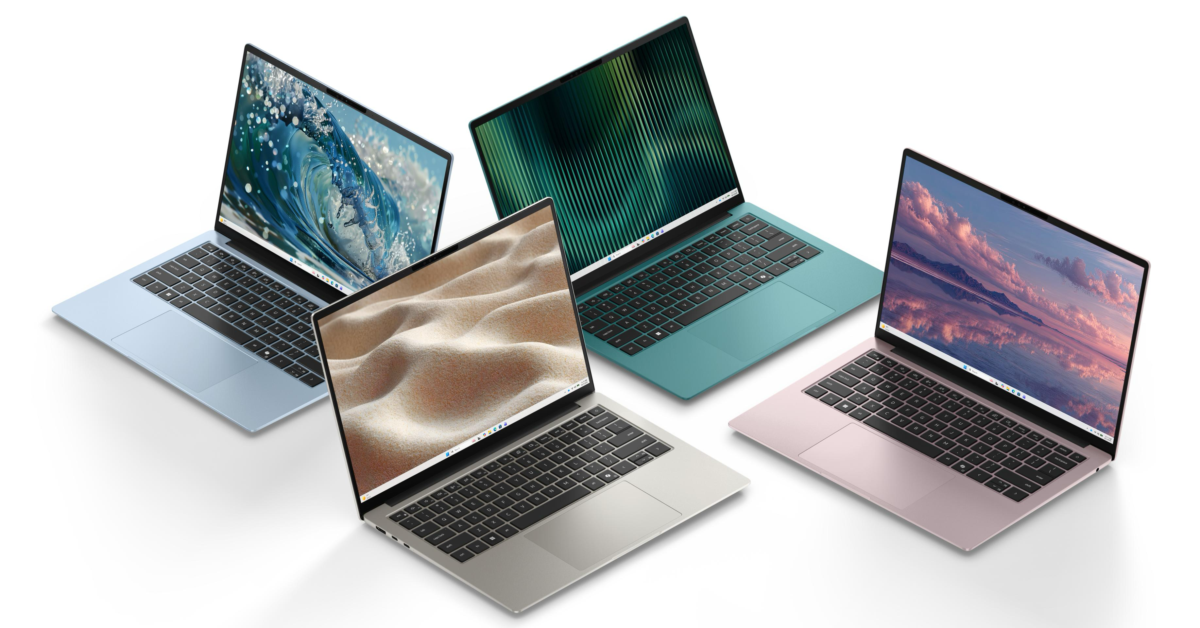
Laptop companies love talking about affordability right up until someone asks for the price. Dell is doing exactly that with the new Dell 14S, a colorful Windows laptop designed for students, young adults, and anyone who wants something lighter than the average budget notebook.
Announced at IFA 2026, the Dell 14S has an aluminum chassis, weighs about 2.5 pounds, and measures just 13.5mm thick. Those numbers put it closer to premium ultraportables than the bulky plastic machines many people still associate with student laptops.
Dell will offer the 14S in Linen, Dusty Rose, Washed Denim, and Velvet Green. I am glad to see a PC manufacturer acknowledge that people might want something besides silver, darker silver, or black, especially when students will carry these machines around for several years.
The colors are not the biggest selling point, though. Dell claims the 14S can stream Netflix for up to 21 hours on a single charge, which sounds fantastic until you dig into how the company reached that number.
Dell conducted the test using a configuration with an Intel Core 5 320 processor, integrated Intel graphics, 8GB of RAM, and a 256GB SSD. More importantly, the display brightness was set to only 150 nits.
That is a fairly dim screen, particularly in a bright classroom, office, or coffee shop. Streaming Netflix under controlled conditions also tells us little about what happens when someone opens 30 browser tabs, joins a video call, edits a document, and forgets about several applications running in the background.
Nobody should purchase the Dell 14S expecting it to deliver 21 hours under every workload. The test still suggests that battery life could be one of its better qualities, but I would like to see independent results at a more realistic brightness before getting excited.
Dell attributes the claimed endurance to a 750ED PNCM high-energy-density battery. The company says the denser cell can run cooler under load and retain its capacity over time without making the laptop heavier or more expensive.
That sounds promising, although battery claims always look best when the machine is new. How the Dell 14S performs after two years of charging, travel, and being tossed into a backpack will matter more to students than the results of one laboratory test.
Dell gives buyers two 16:10 display choices. One option has a 2.8K resolution and 120Hz refresh rate, while the other uses a 2K panel running at 60Hz.
The 2.8K display should provide sharper text and smoother scrolling, but it will almost certainly draw more power. On a 14-inch laptop meant for school and everyday work, the 2K panel may provide the better balance unless Dell makes the upgrade unusually inexpensive.
Processor choices include Intel Core 5 and Core 7 Series 3 chips. Dell says the laptop can handle common student workloads across applications, browser tabs, documents, and video calls, which is about the minimum anyone should expect from a new computer in 2026.
The 8GB of RAM and 256GB SSD used for Dell’s battery testing concern me more than the processor. Dell has not confirmed that this will be the base retail configuration, but 8GB of memory already feels stingy for a Windows laptop expected to survive four years of college.
The Dell 14S also includes a 1080p webcam, two far-field microphones, and stereo speakers tuned for Zoom and Microsoft Teams. Wi-Fi 6E handles wireless connections, while Windows Hello provides faster and more secure sign-in.
Port selection includes two USB-C connections with power delivery, HDMI, and a headphone jack. I appreciate Dell keeping HDMI and the headphone jack because students should not need a bag full of adapters just to connect a classroom display or use wired headphones.
However, Dell does not mention USB4, Thunderbolt, USB-A, or a microSD card reader in its announcements. Anyone with older accessories should wait for the complete specifications before deciding whether the included ports are enough.
Unfortunately, the hardware is not the most confusing part of this announcement. This is the second substantially different laptop called the Dell 14S that Dell has announced in 2026.
Dell introduced the first Dell 14S in May alongside the Dell 16S. That machine targets creators and early-career professionals with Core Ultra processors, higher-end configuration options, a 15.3mm chassis, a starting weight around 3.28 pounds, and an announced starting price of $1,269.99.
The new Dell 14S is thinner, lighter, and aimed at a different category of buyer. It uses different processor branding, comes in different colors, and emphasizes battery life and accessible pricing rather than higher-end performance.
Even Dell appears to recognize the problem. Its own FAQ asks why the company introduced “another Dell 14S” earlier this year before explaining that the two models serve different customers.
Perhaps Dell now considers 14S the name of an entire laptop family rather than one particular computer. If that is the strategy, however, the company has done a poor job of communicating it.
Calling two substantially different laptops by exactly the same name is really poor naming and marketing. Dell could have called this one the Dell 14S Student, Dell 14S Air, Dell 14S Essential, or almost anything else that would help shoppers understand which machine they are looking at.
Instead, customers may need to compare model numbers, processor families, weights, colors, and specification sheets just to distinguish one Dell 14S from another. Normal people do not shop using internal model numbers, and Dell should not expect them to.
Frankly, this makes me question the judgment of Dell’s leadership. How does a company of Dell’s size move two different consumer laptops through product planning, branding, marketing, and final approval without someone stopping to point out the obvious confusion?
This is not some tiny wording mistake buried inside a specification sheet. The product name is one of the first things customers see, and leadership should understand that clear naming matters when asking people to spend hundreds or potentially more than a thousand dollars.
Konstantin Tuv, head of consumer and gaming products at Dell Technologies, said, “Earlier this year we introduced the XPS 13, a premium laptop that raised the bar for the Dell consumer portfolio. The Dell 14S expands that story for students and young adults who want a lightweight laptop they can carry all day, battery life they can depend on and a design that feels personal, at a price point that makes it accessible to more people.”
Dell presents the new 14S as a more affordable alternative to the XPS 13 and Apple’s MacBook Neo. That comparison could make sense, but it is difficult to evaluate value when one of the most important numbers is missing.
Dell repeatedly calls the laptop affordable, accessible, and suitable for college budgets. It has not, however, told us what the new Dell 14S will cost.
The new Dell 14S will arrive in the United States this fall, with pricing coming closer to availability. I like the aluminum construction, low weight, useful ports, color choices, and potential for long battery life, but Dell has buried an appealing laptop beneath a needlessly confusing name and an affordability pitch unsupported by an actual price.
Support independent tech journalism
NERDS.xyz is independently owned and operated. If you enjoy my coverage of Linux, AI, hardware, cybersecurity, and tech culture, consider supporting the site on Ko-fi.
Support NERDS.xyz