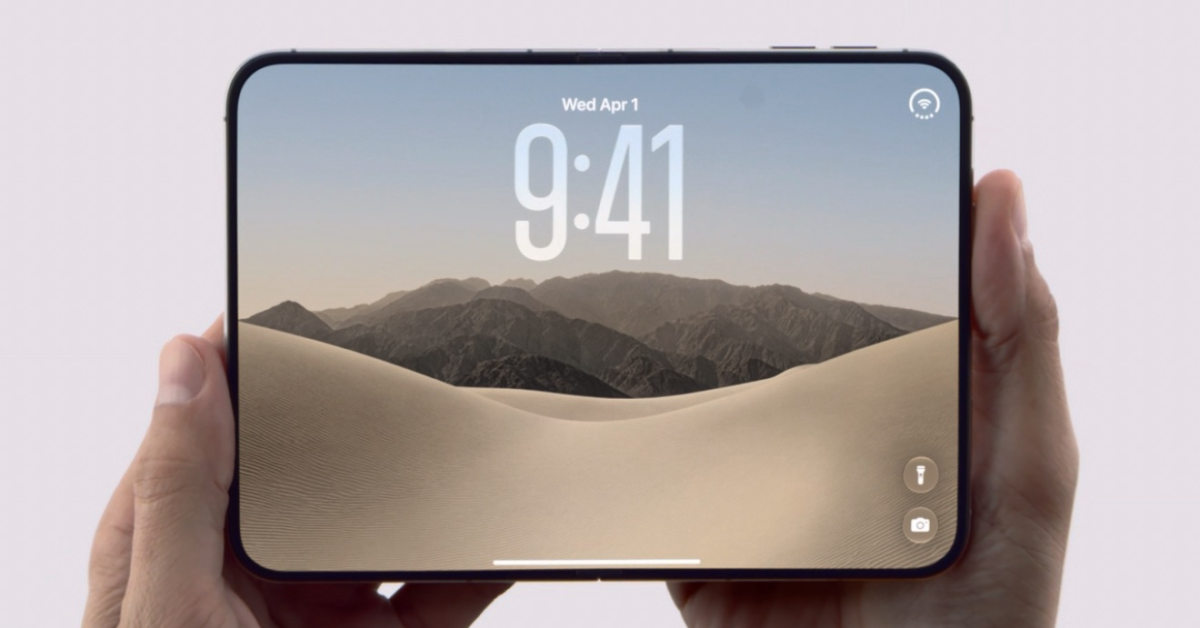
Apple has finally made a foldable iPhone. The new iPhone Duo opens into a 7.6-inch device, closes down to a much more compact 5.4-inch phone, runs on the same A20 Pro chip found in the iPhone 18 Pro lineup, and introduces a version of iOS 27 specifically designed around two displays.
It looks amazing, and this is easily one of the most interesting iPhones Apple has introduced in years. Unfortunately, Apple has attached a starting price of $1,999 to it, which makes the iPhone Duo a non-starter for me.
As interesting as the hardware is, spending two grand on a smartphone before adding AppleCare, accessories, or additional storage is difficult to justify. Still, there is plenty here to like, and Apple appears to have put considerable thought into making the Duo more than an iPhone with a folding screen.
When closed, the iPhone Duo has a 5.4-inch Super Retina XDR outer display that Apple says provides 90 percent of the screen area of an iPhone 18 Pro. Open it and you get a 7.6-inch Super Retina XDR inner display that Apple says is 50 percent larger than the display on an iPhone 18 Pro Max.
Both screens support ProMotion, Always On, and up to 3,000 nits of peak outdoor brightness. Apple is also using a nano-texture finish on the folding display to reduce reflections and make the crease less noticeable, while Apple Pencil with USB-C support is scheduled to arrive later this year.
Rather than putting Face ID on both sides of the device, Apple has returned to Touch ID, integrating the fingerprint sensor into the side button. Users can also unlock the Duo with an Apple Watch, while a FaceTime camera sits underneath the inner display and stays hidden when it isn’t being used.
Durability will obviously be a major question for a $2,000 folding phone. Apple says the Duo uses grade 5 titanium, a hinge consisting of more than 100 components, Ceramic Shield on the back, and Ceramic Shield 2 on the front, while maintaining IP68 water and dust resistance.
The folding screen itself uses a scratch-resistant coating, custom polymer cover layer, high-strength glass, specialized adhesives, and a titanium plate underneath. Apple says the polymer layer offers up to 40 percent greater stiffness than comparable materials used elsewhere in the industry.
Apple is also taking advantage of the folding design for photography. The Duo gets a 48MP Fusion Main camera with an optical-quality 2x option and a 48MP Fusion Ultra Wide camera borrowed from the iPhone 18 Pro models.
Several new camera tricks make use of the second display. Duo Preview can show the person being photographed a live preview on the outer screen, while users can take selfies with the better rear cameras and use that same display for framing.
There is even a feature called Kid Cue that displays Peanuts animations on the outer screen to get children to look toward the camera. As the father of a young child, I can absolutely appreciate the thinking behind that one, because getting a kid to actually look at the camera can sometimes be harder than taking the photo.
Smart Take is another interesting addition. Apple says on-device AI can recognize when subjects are posing and automatically take the photo, potentially allowing the person who would normally be behind the camera to join the shot instead.
Video recording tops out at 4K 120 fps Dolby Vision using the main camera. Because the phone folds, it can also stand on its own for certain shots, potentially eliminating the need for a tripod in some situations.
The software may ultimately be more important than the folding hardware. Apple has redesigned parts of iOS 27 specifically for the Duo rather than simply stretching the existing iPhone interface across a bigger screen.
Opening the Duo can display two Home Screen pages, with Today View positioned on the left. Apple has moved certain interface elements to the sides of the screen, redesigned Dynamic Island for the unusual display arrangement, and made the interface react as the device opens, closes, rotates, and flips.
Most importantly, the larger screen finally brings Split View to iPhone. Two apps can run side by side, users can open two windows from the same app, and frequently used app combinations can be saved as pairs.
That could make the Duo considerably more useful for productivity than a traditional iPhone. Apple says Netflix, Zoom, and Slack are among the third-party apps already being adapted to take advantage of the folding design.
StandBy gets upgraded too, and it no longer requires the Duo to be connected to a charger. The partially folded phone can work as a clock, photo frame, calendar, weather display, or widget dashboard.
Apple Intelligence and the new Siri AI are also central to the experience. Siri can use personal context, understand information shown on the screen, work across messages, emails, and photos, and interact conversationally while another app remains visible alongside it.
Powering everything is A20 Pro, the same chip used in the iPhone 18 Pro lineup. Apple claims up to 35 percent better sustained performance than iPhone 17 Pro, with a 6-core CPU, 7-core GPU, dual 16-core Neural Engine, and 50 percent more unified memory bandwidth.
Heat is managed through a custom vapor chamber, while the Duo uses two batteries, one on each side of the folding chassis. Apple rates battery life at up to 31 hours of video playback using the inner display or 44 hours using the outer display.
The Duo can reach 50 percent charge in around 20 minutes with wired charging. MagSafe and Qi2 wireless charging can reach 50 percent in around 30 minutes under Apple’s testing conditions.
Apple is also going eSIM-only worldwide with the Duo. The company’s N1 wireless chip provides Wi-Fi 7, Bluetooth 6, and Thread, while its C2 cellular modem adds mmWave support in the United States.
Then there is the problem that hangs over everything else: the price. The iPhone Duo starts at $1,999 with just 256GB of storage, while 512GB, 1TB, and 2TB configurations will push the cost even higher.
Apple clearly isn’t positioning the Duo as the normal iPhone for everyone. This is an ultra-premium device for people willing to pay heavily to get Apple’s first attempt at a foldable.
And I have to admit, I want one. The compact outer screen, giant folding display, Split View, camera tricks, Apple Pencil support, and redesigned iOS experience make the Duo far more interesting to me than simply making another conventional iPhone slightly faster.
But $1,999 is where my interest stops turning into a potential purchase. At that price, the iPhone Duo can look absolutely incredible and still be a non-starter for me.
Pre-orders for iPhone Duo begin October 16, with availability starting October 23. It will come in star white and night sky, start with 256GB of storage, and ship with iOS 27.1.
Support independent tech journalism
NERDS.xyz is independently owned and operated. If you enjoy my coverage of Linux, AI, hardware, cybersecurity, and tech culture, consider supporting the site on Ko-fi.
Support NERDS.xyz