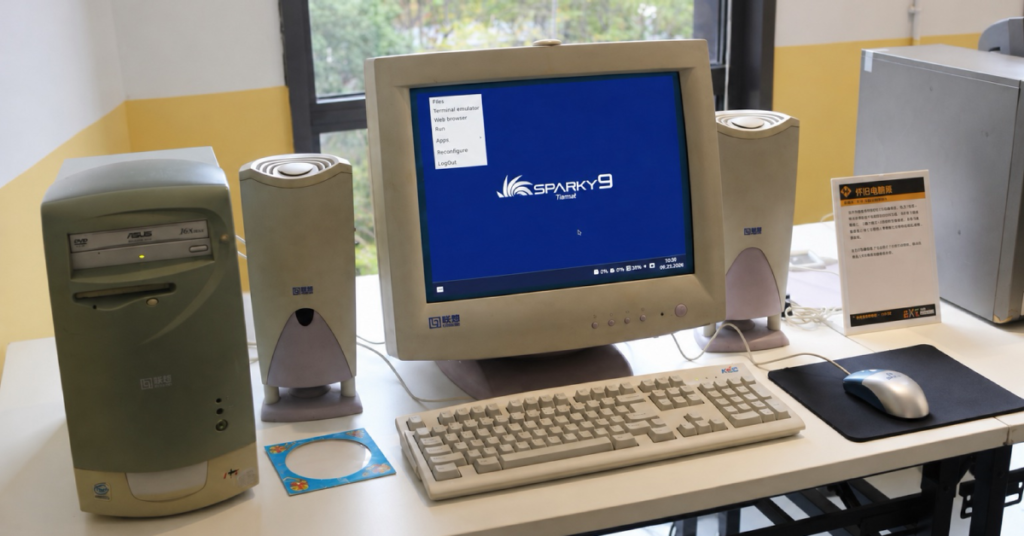

Plenty of Linux distributions are happy to leave aging hardware behind. SparkyLinux is taking a different approach with Sparky 8.4, a new quarterly update that brings 32-bit PC support back to the Debian-based operating system.
SparkyLinux 8.4 is the fourth update to the Sparky 8 “Seven Sisters” series. It remains based on Debian 13 “Trixie” and is fully compatible with the stable Debian release. Packages have been updated from the Debian and Sparky repositories as of August 9, 2026.
The biggest news, however, is the return of 32-bit Live/Install images. Yes, really…
Debian previously dropped support for 32-bit Live/Install ISO images, and SparkyLinux initially followed its lead. The Sparky developers have now reconsidered that decision after determining that plenty of functional computers with 32-bit processors are apparently still out there.
As a result, SparkyLinux 8.4 once again offers i686-pae images for 32-bit PCs. These are available in ultra-light Openbox and CLI editions, which makes sense considering the sort of aging hardware likely to need them.
The return of 32-bit support is pretty cool, at least from a technical and preservation standpoint. Linux has long been a great way to extend the useful life of older computers, and I appreciate seeing a distribution willing to support hardware that much of the industry has abandoned.
Of course, SparkyLinux isn’t standing still for users with newer hardware. The distribution continues to provide 64-bit x86 and ARM64 options as well.
On 64-bit PCs, SparkyLinux 8.4 ships with the Linux 6.12.101 LTS kernel, while additional 7.1.8, 6.18.43 LTS, and 6.12.102 LTS kernels are available through the Sparky repositories. The restored 32-bit edition uses Linux 6.12.102 LTS, while the ARM64 release comes with the 6.18.39-rpi kernel.
Desktop choices remain plentiful. SparkyLinux 8.4 includes KDE Plasma 6.3.6, LXQt 2.1.0, MATE 1.26.0, Xfce 4.20, and Openbox 3.6.1. That gives users considerable flexibility when matching a desktop environment to the capabilities of their hardware. For an especially old PC, a lightweight option such as Openbox is obviously going to make more sense than throwing a heavier desktop environment at it.
The release also includes LibreOffice 25.2.3, although version 26.2.4.2 is available through Debian’s backports repository. Firefox 140.13.0 ESR and Thunderbird 140.13.0 ESR are included as well. Sparky’s repository offers Firefox 153.0.3 for amd64 and ARM64 systems for users who would rather run the latest release instead of the ESR branch.
SparkyLinux has been around for 14 years, and its mission of providing a ready-to-use Linux operating system for older computers continues with this release. Bringing back 32-bit support is certainly cool from a technical and preservation standpoint, especially when so many projects are understandably moving in the opposite direction.
That said, I have to question how much practical value this really has in 2026. A computer old enough to require a 32-bit operating system isn’t merely old at this point. It’s beyond ancient. Keeping hardware out of a landfill is admirable, but there eventually comes a point where continuing to use an extremely old computer stops making much sense.
After all, inexpensive 64-bit PCs aren’t exactly difficult to find. A trip to a local thrift shop can potentially turn up a much newer 64-bit desktop or laptop for very little money. That machine will likely provide a considerably better experience while opening the door to far more modern software.
Still, Linux has always been about choice, and SparkyLinux is giving users another one. I personally can’t see much reason to run a 32-bit PC in 2026, but if you have one sitting around and absolutely refuse to let it retire, SparkyLinux 8.4 is ready for it.
Support independent tech journalism
NERDS.xyz is independently owned and operated. If you enjoy my coverage of Linux, AI, hardware, cybersecurity, and tech culture, consider supporting the site on Ko-fi.
Support NERDS.xyz