Mini PCs are usually associated with saving desk space, running home servers, or handling everyday productivity tasks. GEEKOM, however, is showing that a handful of these tiny computers can be combined to tackle something considerably more demanding.
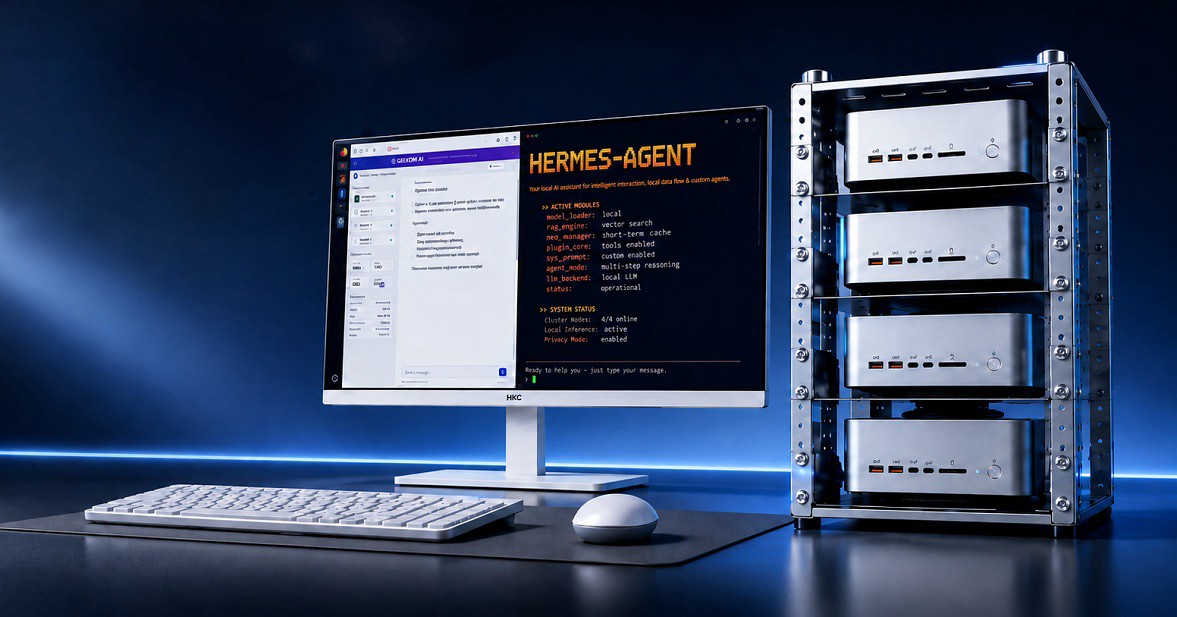
The company has connected four of its A9 Mega Mini PCs to create a local AI cluster capable of running an optimized version of DeepSeek V4 Flash. Rather than relying on a traditional rack-mounted server or sending workloads to a cloud provider, the entire setup runs locally using Ubuntu Linux.
Each GEEKOM A9 Mega is powered by AMD’s Ryzen AI Max+ 395 processor, which combines 16 Zen 5 CPU cores with Radeon 8060S graphics and unified memory. Four machines are then connected over USB4 to create the distributed system.
On the software side, GEEKOM says Ubuntu, AMD ROCm, and DwarfStar are used to distribute the optimized DeepSeek V4 Flash model across the four computers. Applications and AI agents can communicate with the cluster through an OpenAI-compatible API, potentially making it easier to integrate the hardware with existing software.
Using USB4 is particularly interesting. GEEKOM doesn’t require a proprietary high-speed switch or conventional server rack to connect the machines, helping preserve some of the simplicity that makes Mini PCs attractive in the first place.
Of course, the biggest argument for running AI locally is privacy. Businesses could potentially feed internal documents, source code, credentials, contracts, policies, and other sensitive information into an AI model without sending that data to a public cloud service.
GEEKOM suggests the cluster could be used for private knowledge assistants, document analysis, local retrieval-augmented generation, source-code analysis, research, and workflow automation. The company also says its technical implementation has operated with context sizes of up to 250,000 tokens, which could make the setup useful when working with particularly large documents or codebases.
The performance numbers aren’t bad either. According to GEEKOM, the four-node system delivered approximately 14.61 tokens per second at single concurrency, with P95 time to first token of around 0.42 seconds during its 32- and 128-token tests.
Those numbers shouldn’t be interpreted as proof that four Mini PCs can suddenly replace every enterprise AI server, of course. Performance depends heavily on the model, quantization, workload, context size, software stack, and hardware configuration. Still, getting this sort of local inference from four compact computers is interesting.
There’s also some flexibility to the approach. An organization doesn’t necessarily have to buy four systems immediately. GEEKOM says deployments can start with one or two A9 Mega machines and expand to four later. Each computer can still operate independently when it isn’t contributing to distributed inference.
One important detail GEEKOM doesn’t address in its announcement is the total cost of building the four-node cluster. Four Ryzen AI Max+ 395 Mini PCs certainly aren’t going to be cheap, so pricing becomes important when comparing this approach with a workstation, dedicated AI server, or cloud computing.
Even with that unanswered question, the experiment is a nice demonstration of where Mini PCs are heading. These little machines have become considerably more powerful, and the combination of AMD’s latest hardware, Ubuntu Linux, ROCm, and local AI models opens up some interesting possibilities.
GEEKOM may be overselling things a bit by positioning four Mini PCs as an enterprise AI platform, but the underlying idea is compelling. A small Ubuntu Linux cluster that sits on a desk, keeps data local, and can run a large AI model without depending on the cloud is the sort of wonderfully nerdy project that deserves attention.
Support independent tech journalism
NERDS.xyz is independently owned and operated. If you enjoy my coverage of Linux, AI, hardware, cybersecurity, and tech culture, consider supporting the site on Ko-fi.
Support NERDS.xyz