Mini PCs keep getting more interesting. What used to be tiny little office desktops are now turning into serious machines for AI workloads, media servers, virtualization, and massive local storage. The newest example comes from Beelink, which just expanded its ME Pro lineup with several new models aimed squarely at power users and creators.
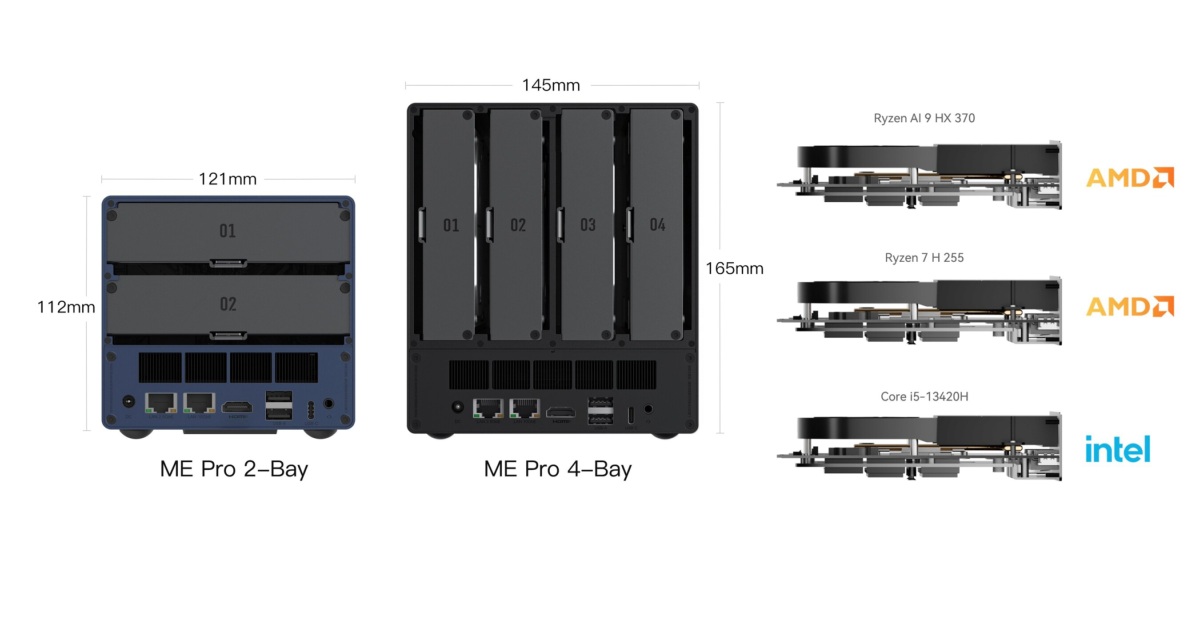
The refreshed ME Pro family includes both 2 bay and 4 bay versions powered by Intel Core i5-13420H, AMD Ryzen 7 H 255, and AMD Ryzen AI 9 HX 370 processors. That last chip is the one that really grabbed my attention because it pushes the system much deeper into local AI territory.
SEE ALSO: Beelink launches Wildcat Lake mini PCs with Intel 18A and AI features
According to Beelink, the Ryzen AI 9 HX 370 model can deliver up to 80 TOPS of AI performance, making it suitable for local AI processing and large model inference. In other words, this is not just some cute little mini PC anymore. Folks experimenting with local AI tools, offline assistants, image generation, or self hosted workloads may find this thing pretty appealing.
What makes the ME Pro especially interesting, however, is how different it is from most mini PCs currently on the market. Typically, a mini PC is just a tiny desktop computer with maybe room for one SSD and limited upgrade options. The ME Pro takes a very different approach by blending mini PC hardware with NAS style storage expansion and workstation capabilities.
Storage is clearly the star of the show here.
The 2 bay ME Pro supports four SSDs alongside two HDD bays for up to 76TB of storage. Meanwhile, the larger 4 bay version can handle four SSDs and four hard drives with support for as much as 136TB total capacity. That is honestly kind of absurd for something compact enough to sit on a desk.
As someone who likes the idea of local storage instead of dumping everything into the cloud, I find this trend pretty exciting. AI models, video projects, backups, Linux ISOs, media libraries, and virtual machines can eat storage fast. Having a compact machine that combines compute power and huge storage capacity actually makes a lot of sense.
The networking setup also separates the ME Pro from typical mini PCs. Every model ships with both 10GbE and 2.5GbE Ethernet ports, which is the kind of thing you usually expect from higher end NAS devices or workstation hardware rather than a compact desktop. Home lab users and creators moving giant files around should appreciate that.
Another thing I like is Beelink’s modular approach. The company says motherboard modules are interchangeable within each chassis category, meaning users may be able to upgrade processors later without replacing the entire system. That is refreshing these days, especially when so much consumer hardware feels intentionally disposable.
The design choices are also kind of fun. Intel models come in navy blue, AMD versions use black with red accents, and an ARM based model is apparently coming later in pearl white. I am definitely curious about that ARM version, especially if Linux support ends up being decent.
What I find most interesting here is how blurred the line has become between a NAS and a desktop computer. A few years ago, if somebody wanted lots of storage, they probably bought a Synology box. Now companies like Beelink are basically saying, “Why not combine the NAS and workstation into one machine?”
For a lot of nerds, that idea is probably going to sound pretty appealing.
Of course, there are still some unanswered questions. Beelink did not announce pricing yet, and thermals will matter quite a bit in a compact chassis loaded with drives and high performance hardware. Noise could also become an issue depending on how many spinning drives users install.
Still, I think the ME Pro lineup looks genuinely interesting. It feels like the kind of product designed for the growing number of folks running AI tools locally while also wanting massive storage and fast networking in a small footprint.
And yeah, I kind of want one.
Support independent tech journalism
NERDS.xyz is independently owned and operated. If you enjoy my coverage of Linux, AI, hardware, cybersecurity, and tech culture, consider supporting the site on Ko-fi.
Support NERDS.xyz