
AI coding tools are getting smarter fast, but there’s a growing problem that nobody can ignore anymore. These agents need access to credentials. Databases, APIs, cloud platforms, deployment pipelines, and internal services all require secrets to function. Unfortunately, a lot of developers are still handling those credentials in ways that could easily become a disaster.
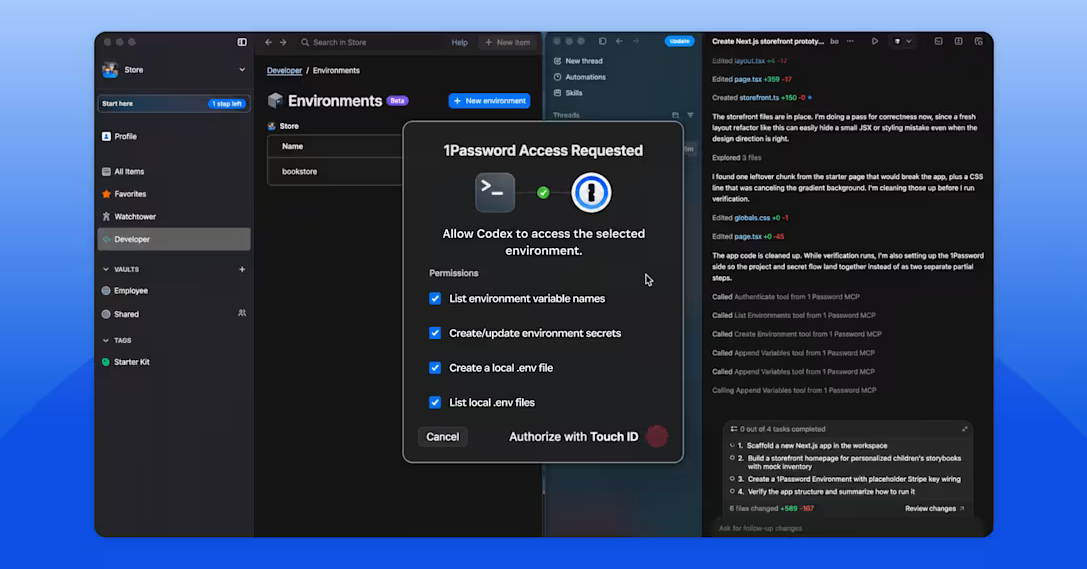
1Password announced a new integration with OpenAI that tries to tackle the issue head-on. The company says its new 1Password Environments MCP Server for Codex lets developers give OpenAI Codex access to credentials without exposing those secrets directly to the AI model.
You know what? That’s a pretty important distinction.
Right now, many developers are tossing API keys into prompts, saving credentials in .env files, or hardcoding secrets into repositories just to make AI coding assistants work smoothly. Sure, it gets the job done, but it also creates an ugly security situation. Once credentials end up inside an AI model’s context window, all bets are off. Those secrets could potentially get logged, cached, surfaced unexpectedly, or accidentally exposed later.
1Password’s pitch is simple. AI agents should be able to use credentials without actually possessing them.
Instead of passing secrets directly into Codex, the credentials stay encrypted inside 1Password. The company injects them only at runtime into authorized processes after user approval. The secrets never appear in prompts, code, terminals, repositories, or the model context itself.
That sounds a whole lot safer than the current “copy and paste your keys into the chatbot” strategy some folks seem perfectly comfortable with.
Nancy Wang, CTO of 1Password, didn’t sugarcoat the problem either. She said, “A credential that persists is already compromised.”
Honestly, she’s not entirely wrong. Developers have been leaving secrets lying around in repositories and local machines for years. AI just amplifies the risk because these tools operate at a much larger scale and can touch a lot more systems very quickly.
OpenAI also appears to recognize the danger here. Nick Steele, who works on agent security at the company, said secure runtime access is becoming critical as coding agents move deeper into real production workflows.
The integration itself uses a local MCP server bundled into 1Password’s developer tools and desktop app. MCP, or Model Context Protocol, is quickly becoming one of the standard ways AI systems interact with external tools and services. In this case, the MCP layer acts as a controlled gateway between Codex and sensitive credentials.
Codex can still configure environments, manage variables, scan repositories for exposed secrets, and help developers move plaintext credentials into secure storage. But according to 1Password, the AI model never directly sees the secret values themselves.
That architecture is probably going to matter a lot as AI coding agents evolve from glorified autocomplete tools into systems that actively deploy software and manage infrastructure.
The bigger picture here is hard to miss. The tech industry is racing toward “agentic” workflows where AI systems don’t just assist humans but actually perform tasks autonomously. Once that happens, identity management and credential security become massive concerns.
And frankly, this is where a lot of the current AI hype starts colliding with reality.
Companies want developers moving faster with AI, but nobody wants sensitive credentials floating around inside model contexts or sitting unprotected inside repositories. Those two goals don’t naturally coexist without some kind of security layer sitting in the middle.
That’s exactly the role 1Password is trying to fill here.
Whether developers actually adopt better secret management habits is another question entirely. A lot of coders still take shortcuts when deadlines pile up. But if AI coding agents are truly going mainstream, the industry probably doesn’t have much choice anymore.
Support independent tech journalism
NERDS.xyz is independently owned and operated. If you enjoy my coverage of Linux, AI, hardware, cybersecurity, and tech culture, consider supporting the site on Ko-fi.
Support NERDS.xyz