
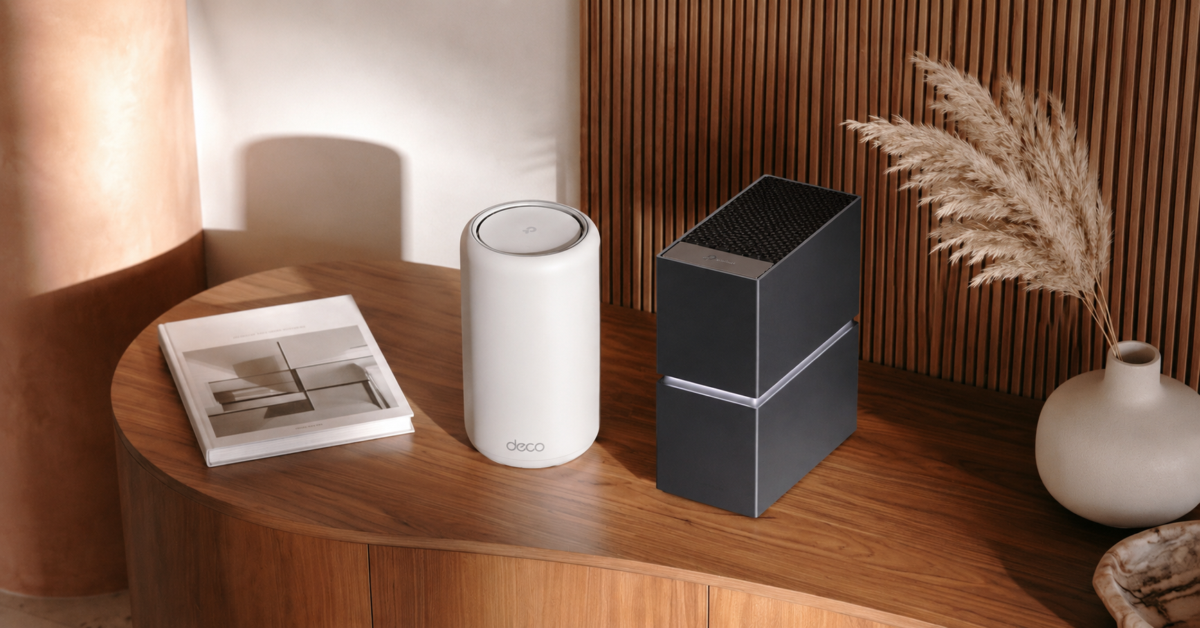
Wi-Fi 7 is barely settled into the mainstream, but TP-Link is already showing off what comes next. At IFA 2026 in Berlin, the company unveiled its first Wi-Fi 8 products, including the Archer 8 Ultra router and Deco 8 Ultra mesh system.
The new hardware is based on IEEE 802.11bn, the developing standard better known as Wi-Fi 8. While enormous theoretical speeds will inevitably get attention, TP-Link is pitching this generation around something arguably more important: making Wi-Fi more reliable.
That means improving connections at the edges of a home, dealing with congestion when many devices are online, and reducing the impact of interference. TP-Link bundles its approach to those problems under the name StabilityEngine.
Several Wi-Fi 8 technologies sit behind it. Enhanced Long Range (ELR) and Distributed Resource Units (DRU) are intended to improve coverage and uplink performance for devices farther from the router. Non-Primary Channel Access (NPCA) can make additional spectrum available when part of a channel is busy, while Unequal Modulation (UEQM) and new Modulation and Coding Schemes (MCS) are designed to keep connections performing under difficult conditions.
In other words, Wi-Fi 8 is not just about making the speed-test number bigger. The more interesting promise is a connection that works better when you are farther from the router or have a house full of devices competing for bandwidth.
Leading TP-Link’s lineup is the Archer 8 Ultra BN19000, also known as the Archer BN800. The tri-band Wi-Fi 8 router offers up to 19 Gbps of aggregate wireless bandwidth, 10 Gbps wired connectivity, and 18 internal antennas.
Those internal antennas also allow TP-Link to ditch the familiar router-with-spider-legs appearance. The Archer 8 Ultra has a much cleaner design with a dual-tone grille and a soft status light instead of a collection of blinking LEDs.
“We stopped building a piece of networking equipment and started designing for the home,” said Gary Chang, who leads industrial design at TP-Link’s Irvine headquarters. “When a router’s design becomes something people want to display, it ends up exactly where it performs best.”
There is a practical benefit to that approach. A router works best when it is positioned properly, yet ugly networking equipment often gets shoved behind a television, inside furniture, or into some other terrible location. If people are willing to leave the Archer 8 Ultra out in the open, its appearance could indirectly help its performance.
For people who need mesh coverage, there is the Deco 8 Ultra BN22000, also called the Deco BN85. This tri-band Wi-Fi 8 system pushes the claimed aggregate wireless bandwidth to 22 Gbps and includes 10 Gbps wired connectivity.
TP-Link says a three-pack can cover up to 9,800 square feet and support more than 200 connected devices. As always, those coverage numbers should be treated as best-case manufacturer estimates. Walls, interference, placement, construction materials, and client hardware can dramatically change what you actually experience.
The Archer and Deco models are only the beginning. TP-Link plans a broader Deco 8 mesh release in the first quarter of 2027, followed by the Roam 8 Wi-Fi 8 travel router, range extenders, and adapters during the second quarter.
Archer 8 Ultra pre-orders are scheduled to begin in select regions on September 30, 2026. TP-Link will also hold a global online launch event that day to reveal additional specifications and more of its Wi-Fi 8 lineup. Pricing has not been announced.
If you recently bought an expensive Wi-Fi 7 router, there is no reason to toss it in the trash. Wi-Fi 8 is still based on a developing standard, and compatible client devices will need time to become common.
Still, the direction is encouraging. Faster Wi-Fi is nice, but most people probably do not need 20-plus Gbps of theoretical wireless bandwidth at home. Better range, less interference, and fewer random connection problems could make Wi-Fi 8 much more meaningful.
Support independent tech journalism
NERDS.xyz is independently owned and operated. If you enjoy my coverage of Linux, AI, hardware, cybersecurity, and tech culture, consider supporting the site on Ko-fi.
Support NERDS.xyz